

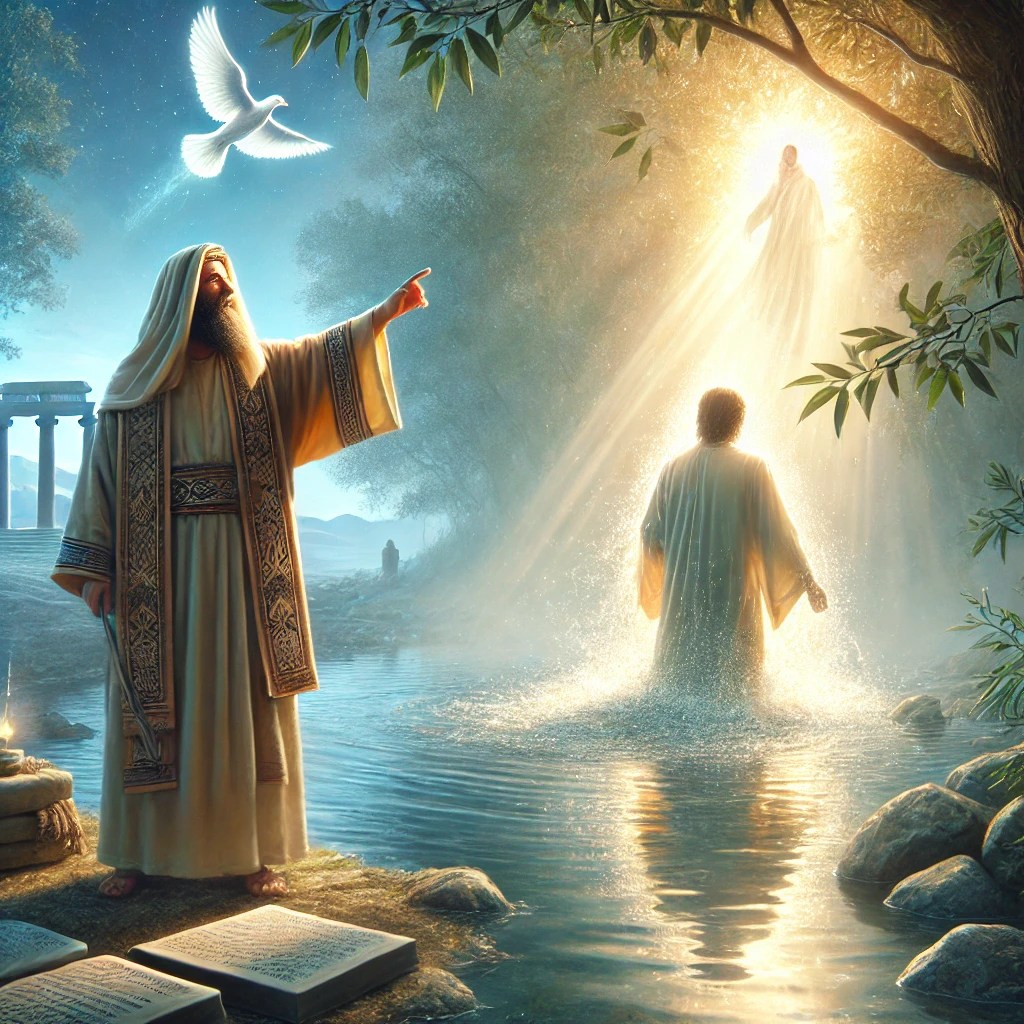
Repentance and Baptism: Rooted in the Old Testament
It is often assumed that the concepts of repentance and baptism find their origin in the New Testament through the ministry of John the Baptist and the teachings of Jesus Christ. However, we can find these beliefs deeply rooted in the Old Testament, anticipating the redemptive efforts of Christ
Baptism in the Old Testament: Foreshadowing a New Covenant
In the Old Testament, although the ritual of baptism as we know it today did not exist, various practices symbolized cleansing and renewal through water. Ceremonial washings, such as those described in Leviticus 15, were required for ritual purity, illustrating the need for holiness before God, though external rituals alone could not achieve this. Water also held significant meaning in stories like the Flood and the crossing of the Red Sea, where it served both as an instrument of judgment and as a means of salvation. These narratives foreshadowed the concept of baptism as a transformative passage, representing the end of an old life and the beginning of a new one with God. In the New Testament, baptism takes on this deeper meaning, symbolizing a “death” to sin and a “resurrection” to new life, connecting the themes of purification and renewal found in the Old Testament to the work of Christ.
Repentance in the Old Testament
Repentance is very important and integral to the understanding of the covenant relationship between God and His people. To repent literally means “to turn” or “return”; the idea that is carried by this word is to turn away from sin and return to God, aligning one’s life with His commandments and covenant.
1. The Call to Repentance: Prophetic Voices
The prophets of Israel were the primary voices calling the people to repentance. Prophets like Isaiah, Jeremiah, and Hosea warned of impending judgment as a result of Israel’s faithlessness and called the nation to repent.
- Isaiah 55:6-7:
“Seek the Lord while he may be found; call upon him while he is near; let the wicked forsake his way, and the unrighteous man his thoughts; let him return to the Lord, that he may have compassion on him, and to our God, for he will abundantly pardon.” - Jeremiah 3:12-14:
“Go and proclaim these words toward the north, and say, Return, thou backsliding Israel, saith the Lord; and I will not cause mine anger to fall upon you: for I am merciful, saith the Lord, and I will not keep anger for ever. Only acknowledge thine iniquity, that thou hast transgressed against the Lord thy God, and hast scattered thy ways to the strangers under every green tree, and ye have not obeyed my voice, saith the Lord. Turn, O backsliding children, saith the Lord; for I am married unto you: and I will take you one of a city, and two of a family, and I will bring you to Zion.” - Hosea 14:1-2:
“O Israel, return unto the Lord thy God; for thou hast fallen by thine iniquity. Take with you words, and turn to the Lord: say unto him, Take away all iniquity, and receive us graciously: so will we render the calves of our lips.”
2. The Role of Rituals: Sacrifices and Offerings
Repentance of the heart was often accompanied by rituals such as sacrifices and offerings in the Old Testament. These rituals were superficial in character; they pointed to the need for a purification of the heart which sacrifices could not afford.
- Deuteronomy 29:4 states:
“Yet the LORD hath not given you a heart to perceive, and eyes to see, and ears to hear, unto this day.”
This verse reflects Moses’ acknowledgment that despite all the laws, the people still lacked the spiritual understanding and transformation needed to truly follow God. The Mosaic Law was given to guide and instruct, but it did not have the power to change the heart, which remained resistant and unresponsive.
This limitation of the Law is further emphasized in the prophetic writings, where the prophets look forward to a time when God would give His people a new heart and spirit, as mentioned in Ezekiel 36:26-27, enabling them to live in true obedience to Him.
The Prophecy of Ezekiel 36:26-27: The Promise of a New Heart and Spirit
In Ezekiel 36:26-27, God foretells a profound transformation for His people:
“A new heart also will I give you, and a new spirit will I put within you: and I will take away the stony heart out of your flesh, and I will give you a heart of flesh. And I will put my spirit within you, and cause you to walk in my statutes, and ye shall keep my judgments, and do them.”
The prophecy found in Ezekiel 36:26-27 shows a very important link between the Old Testament themes of repentance and cleansing, and the New Testament reality of baptism and spiritual renewal. This prophecy anticipated a time when God would fundamentally change the hearts of His people, replacing their hardened hearts with hearts of flesh and imparting His Spirit within them, enabling them to live in obedience to His commandments.
John’s Baptism: The Fulfillment of Prophecy
John the Baptist’s ministry can be seen as one that fulfilled these Old Testament prophecies. His call to repentance in the wilderness reminisced the old prophetic calls but carried a new sense of urgency:
“Repent, for the kingdom of heaven is at hand” (Matthew 3:2).
1. Baptism as Preparation for the Messiah
The baptism administered by John was a forerunner, preparing people for a greater baptism that Jesus would bring, the baptism with the Holy Spirit and fire. As John declared in Matthew 3:11, “I baptize you with water for repentance, but he who is coming after me is mightier than I… He will baptize you with the Holy Spirit and fire.” This baptism signified the need for a deeper purification and transformation, one that only the Messiah could fulfill. Through this greater baptism, the people would receive a new heart and Spirit, as prophesied by Ezekiel, equipping them to live according to God’s commandments.
2. The Fulfillment in Christ
Jesus’ own baptism by John, though He was sinless, marked the beginning of His public ministry and identified Him with the people whom He came to save. This hints at the ultimate act of cleansing and renewal that will be achieved through His death and resurrection.
The heartfelt plea in Hosea 14:1-2 for Israel to return to God, seeking His forgiveness and grace, ties directly to the fulfillment of Ezekiel’s promise in Christ. It is in Christ that the promise of Ezekiel 36:26-27 is realized, as believers are graced with the Spirit of Christ, empowering them to live according to His commandments.
Romans 8:9 confirms this, saying, “But you are not in the flesh but in the Spirit, if indeed the Spirit of God dwells in you. Now if anyone does not have the Spirit of Christ, he is not His.” Here, we see “Spirit of God” and “Spirit of Christ” used in a way that underscores their oneness, showing that God’s Spirit is fully present in Christ. This new life, made possible by being born again in Him, marks the transformation from the old life of sin to a life of obedience and fellowship with God.
The Continuity of God’s Redemptive Plan
In the Old Testament, themes of repentance, ritual washing, and animal sacrifices were woven into the spiritual life of Israel, each pointing to a profound need for reconciliation and preparation for God’s future promise. Repentance called people back to God, ritual washing symbolized purity, and animal sacrifices reminded them of the cost of sin, each one a shadow of something greater that was to come.
As we move into the New Testament, these elements find their ultimate fulfillment in Christ. John the Baptist’s call to repentance set the stage, not only for outward change but for true, inner transformation. With Jesus’ arrival, repentance and baptism were redefined, becoming signs of renewal by the Holy Spirit, an internal transformation rather than a mere external ritual.
Likewise, the system of animal sacrifices reaches its ultimate purpose in Christ. Jesus, as the “Lamb of God,” embodies the perfect and final sacrifice, accomplishing what the blood of animals could only temporarily address, a permanent and complete atonement for humanity’s sin. This fulfillment in Jesus’ life, death, and resurrection unites the Old and New Testaments and gives us a richer understanding of God’s faithfulness and love throughout time
“Jesus answered, ‘Verily, verily, I say unto thee, Except a man be born of water and of the Spirit, he cannot enter into the kingdom of God.’” (John 3:5)
 Spread the Spirit
Share your thoughts!