

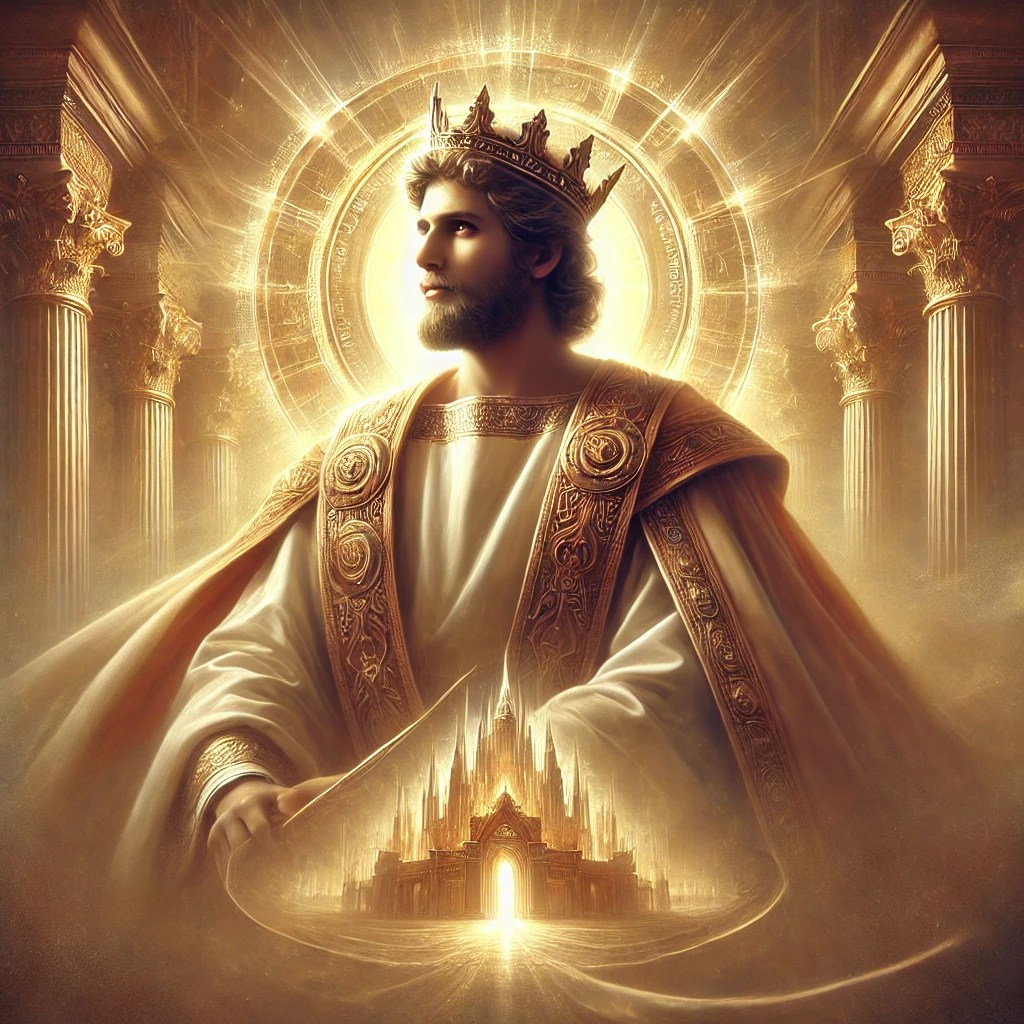
God’s promise to King David, recorded in 2 Samuel 7, stands as a prophetic cornerstone, a commitment that David’s lineage would produce a King whose reign would never end. This covenant foretold a descendant from David’s own flesh who would establish an everlasting kingdom. As the New Testament reveals, this promise finds ultimate fulfillment in Jesus Christ, who uniquely embodies both divine authority and human lineage. Through Jesus, God’s own presence takes on human form, bridging the divine and human to fulfill His eternal promise to David.
The Covenant with David: A Promise of an Everlasting Kingdom
The covenant given to David through the prophet Nathan reveals God’s plan to establish a kingdom that would last forever:
“When your days are fulfilled and you rest with your fathers, I will set up your seed after you, who will come from your body, and I will establish his kingdom. He shall build a house for My name, and I will establish the throne of his kingdom forever.”
— 2 Samuel 7:12-13
This prophecy promises that a descendant from David’s own lineage would build a “house” for God’s name, one that would outlast any human kingdom. Solomon, David’s son, began to fulfill this by constructing the physical temple in Jerusalem, but only Jesus could bring this promise to its full and eternal completion. As a descendant of David, Jesus came to earth as the true, living embodiment of God’s presence, establishing a spiritual house that goes beyond any physical structure.
The Body as the New House: Jesus’ Teaching
Jesus profoundly spoke of the shift to this new “house” by describing His own body as a temple, indicating that God’s presence would no longer be limited to a physical place. In John 2:19-21, Jesus said:
“Destroy this temple, and in three days I will raise it up.”
The people responded, “It has taken forty-six years to build this temple, and will you raise it up in three days?” But He was speaking about the temple of His body.
By calling His body a temple, Jesus revealed that He was fulfilling God’s promise to “build a house for My name.” Through His resurrection, Jesus established a new, living temple. This was not a structure of stone, but rather His own presence with us, a place for God to dwell among His people forever.
Believers as Living Temples: Becoming Part of the Eternal House
Jesus extended this new “house” even further, inviting believers to become part of an eternal, spiritual temple. Through faith in Jesus, the living Word of God, believers receive the Holy Spirit, who dwells within them and makes them part of the ongoing fulfillment of God’s promise to David. This transformation, however, goes beyond faith alone; it fulfills Old Testament prophecies where God promised to give His people a new heart, empowered by His Spirit, to walk in His ways and keep His commandments.
The connection between God’s dwelling place and obedience to His commandments is seen clearly in 1 Kings 6:12-13. During the building of the First Temple, God spoke to Solomon:
“Concerning this house that you are building, if you will walk in My statutes and obey My rules and keep all My commandments and walk in them, then I will establish My word with you, which I spoke to David your father. And I will dwell among the children of Israel and will not forsake My people Israel.”
At first, Solomon sought to obey God’s commandments and Honor the covenant by building the temple. However, later in life, Solomon turned to idolatry, building altars to foreign gods and failing to keep God’s commands fully. This disobedience led to God’s judgment and the eventual division of the kingdom after Solomon’s death, showing that Israel’s faithfulness to God’s commandments was essential for His presence to remain with them.
In contrast, Jesus perfectly kept God’s commandments throughout His life, fully abiding by the law. In John 15:10, Jesus said, “If you keep my commandments, you will abide in my love, just as I have kept my Father’s commandments and abide in his love.” By living in complete obedience, Jesus exemplified what it means to follow God faithfully and prepared the way for a new covenant.
After His resurrection, Jesus carried out God’s plan for His presence to dwell among humanity by sending the Holy Spirit to live within each believer, transforming them into “living temples” of His presence. This accomplishment aligns with Ezekiel 36:26-27, where God promises, “I will give you a new heart and put a new spirit within you; I will take the heart of stone out of your flesh and give you a heart of flesh. And I will put My Spirit within you and cause you to walk in My statutes, and you will keep My judgments and do them.”
Through the Holy Spirit, believers are empowered to live according to God’s commandments, becoming the “house” where God dwells. Jesus’ perfect obedience and the indwelling Spirit now allow believers to fulfill God’s commandments, not by their own strength, but by His Spirit within them.
Paul echoes this idea in 1 Corinthians 6:19-20, highlighting that each believer’s body is now a temple of the Holy Spirit:
“Do you not know that your body is a temple of the Holy Spirit within you, whom you have from God? You are not your own, for you were bought with a price. So glorify God in your body.”
Together, believers form a living, growing spiritual house, fulfilling God’s promise to David and building on the foundation established in 1 Kings 6:12-13. This “house” is not limited by walls or location but is a community of transformed hearts, committed to following God’s ways as empowered by His Spirit.
Jesus, the Son of David: His Human Lineage
By being born in the line of David, Jesus completes the human side of this prophecy as the “Son of David.” His genealogy in Matthew 1 traces His lineage directly to David, affirming His true humanity and royal heritage.
“Concerning His Son, who was descended from David according to the flesh.”
— Romans 1:3
This verse confirms Jesus’ human descent. His birth, life, and experiences, including His hunger, grief, and suffering, are all evidence of His genuine humanity. Yet, in this one person, God fully dwelled, experiencing life as we do while remaining God with us.
Jesus as the Divine Son: Fulfilling God’s Eternal Promise
2 Samuel 7:14 speaks of God’s relationship with the future King as “Father” and “Son,” foreshadowing the unique role that Jesus would ultimately fulfill:
“I will be his Father, and he shall be My son.”
While this prophecy initially applied to Solomon, who would build the physical temple, its ultimate fulfillment came through Jesus, who was not merely a human son of David but also the embodiment of God Himself. The New Testament deepens this understanding by revealing Jesus as God’s chosen and beloved Son.
At Jesus’ baptism, Matthew 3:17 records:
“And behold, a voice from heaven said, ‘This is My beloved Son, with whom I am well pleased.’”
Similarly, at His transfiguration, Luke 9:35 states:
“And a voice came out of the cloud, saying, ‘This is My Son, My Chosen One; listen to Him!’”
These divine declarations set Jesus apart as more than an earthly king. He is both the Son of David and the visible expression of God’s presence, fulfilling the prophecy as the eternal Son who reigns in unity with God Himself. This affirmation underscores His unique role, showing that Jesus is the promised King with both divine authority and a human lineage, bringing the prophecy of an everlasting kingdom to completion.
The Eternal Kingdom of Jesus
The eternal nature of the kingdom requires a King who transcends human limits. Daniel 7:13-14 beautifully captures the vision of this everlasting dominion given to Jesus, described as the “Son of Man,” a title He often used for Himself.
“I saw in the night visions, and behold, with the clouds of heaven there came one like a son of man, and he came to the Ancient of Days and was presented before him. And to him was given dominion and glory and a kingdom, that all peoples, nations, and languages should serve him; his dominion is an everlasting dominion, which shall not pass away, and his kingdom one that shall not be destroyed.”
— Daniel 7:13-14
This passage highlights the universal and eternal scope of Jesus’ kingship. Through His resurrection and ascension, Jesus inaugurated His reign as the fulfillment of God’s promise to David, establishing a kingdom that will never end. He is not merely an earthly ruler, but the one through whom God’s presence, authority, and dominion are fully established forever.
In Jesus, God’s eternal kingdom is realized, encompassing all peoples and enduring for all time. His dominion fulfills the covenant with David, marking the establishment of an everlasting “house” and throne that cannot be shaken.
Jesus as the Fulfillment of God’s Covenant with David
In Jesus, the promise to David is fully realized. He is the Son of David according to the flesh, sharing in our humanity, and He is also the everlasting manifestation of God’s presence, establishing a kingdom that will never end. Jesus, as God’s visible expression, bridges heaven and earth in a single, unified form.
“And He shall reign over the house of Jacob forever, and of His kingdom, there will be no end.”
— Luke 1:33
Through Jesus, God has fulfilled His covenant with David in a way that transcends human understanding. He reigns as the eternal King, one with the Father, and His kingdom endures forever, offering hope and redemption to all who believe.
 Spread the Spirit
Share your thoughts!