

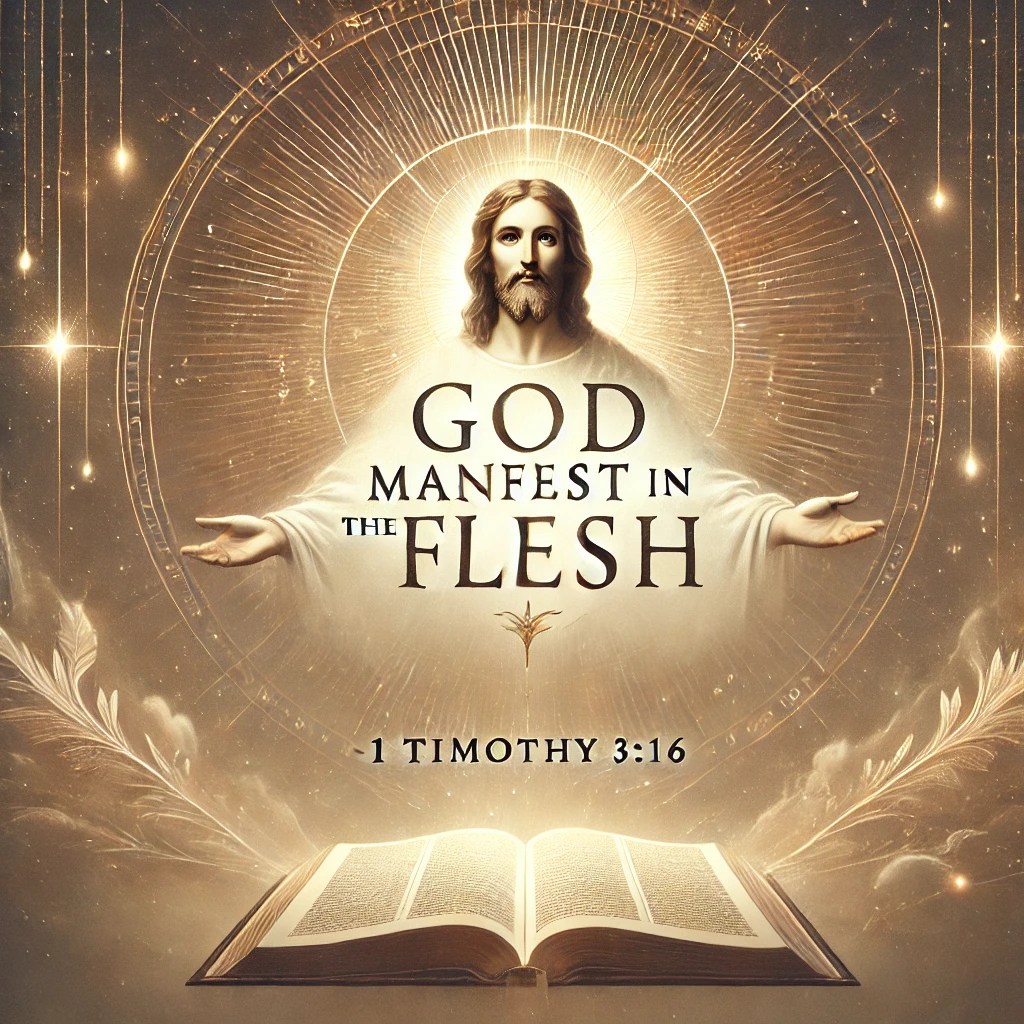
The Bible consistently emphasizes the oneness of God, declaring Him to be the sole Creator, Savior, and Redeemer. Despite this clarity, the doctrine of the Trinity introduces a complex interpretation of God as three distinct persons. This post explores commonly cited Trinitarian proof texts, demonstrating how they align with the Bible’s message of God’s unity and simplicity rather than a triune nature.
1. Genesis 1:26 – “Let Us Make Man in Our Image”
- Trinitarian Claim:
The plural language implies a conversation between persons in the Godhead.
- Biblical Response:
The use of “us” in Genesis 1:26 is widely understood as a plural of intensity or majesty, a linguistic feature of ancient Hebrew. As Keil and Delitzsch explain, this does not suggest a plurality of persons but the majestic deliberation of one God. Verse 27 immediately clarifies this: “So God created man in His own image” (singular), affirming the creation was the act of one God (Keil and Delitzsch Commentary on the Old Testament).
Further solidifying this truth, the New Testament declares that “Jesus is the image of the invisible God” (Colossians 1:15). This revelation decisively burns the flawed notion of multiple persons in the Godhead, as Jesus is the visible manifestation of the one, invisible Creator. There is no room for eternal confusion here: God’s unity shines brightly, leaving doctrines like the Trinity to crumble under the weight of Scripture’s simplicity and clarity.
2. Matthew 28:19 – “Baptizing Them in the Name of the Father, and of the Son, and of the Holy Spirit”
- Trinitarian Claim:
This verse identifies three distinct persons.
- Biblical Response:
The word “name” is singular, signifying one ultimate authority. Throughout Acts, the apostles consistently baptized in the name of Jesus Christ (Acts 2:38, Acts 8:16, Acts 19:5), showing that they understood Jesus as the full and complete embodiment of the Father, Son, and Holy Spirit. The singular name highlights the unified revelation of God through Christ, as declared in Isaiah: “By Myself I have sworn; truth has gone out from My mouth, a word that will not be revoked: Every knee will bow to Me, every tongue will swear allegiance” (Isaiah 45:23).
This profound declaration finds its fulfillment in Jesus, the Word made flesh and the visible manifestation of God’s authority and power. It is because Jesus embodies the fullness of God that “at the name of Jesus every knee should bow, in heaven and on earth and under the earth, and every tongue confess that Jesus Christ is Lord, to the glory of God the Father” (Philippians 2:10-11). Bowing to Jesus’ name is not a recognition of a separate being but an acknowledgment of the one true God revealed fully in Him.
3. John 1:1 – “The Word Was With God, and the Word Was God”
- Trinitarian Claim:
The Word is a distinct person who existed alongside God.
- Biblical Response:
The Word (Greek: logos) refers to God’s self-expression and eternal plan, not a separate person. When John writes that the Word was with God, it indicates that God’s purpose and expression were inherent to Him. The Word became flesh in Jesus Christ (John 1:14), revealing God’s plan in action, not a separate divine being.
4. John 14:28 – “The Father Is Greater Than I”
- Trinitarian Claim:
This statement reflects a hierarchy within the Godhead.
- Biblical Response:
Jesus speaks here from His humanity, not His divine nature. As a man, He humbled Himself to fulfill God’s redemptive purpose (Philippians 2:7). His statement reflects submission, not inferiority. In His deity, Jesus declares, ‘I and the Father are one’ (John 10:30), affirming His divine nature. As the Lamb slain since the foundation of the world (Revelation 13:8), Jesus’ mission was not a separate act but the eternal plan of God manifesting in time to redeem humanity.
5. John 17:21 – “That They May Be One, as We Are One”
- Trinitarian Claim:
This verse highlights distinct persons within the Godhead.
- Biblical Response:
The unity described here is relational, not numerical. In John 17, Jesus prays for believers to share the same unity He has with the Father, a unity rooted in purpose and spirit rather than a distinction of persons. This relational unity serves as the foundation of the Church, where believers are united in one spirit and one purpose to glorify God, edify one another, and bear collective witness to His Truth. Such harmonious oneness reflects the Bible’s affirmation of God’s singular nature, as proclaimed in Isaiah 44:6: “Thus says the Lord, the King of Israel, and his Redeemer, the Lord of hosts: ‘I am the first, and I am the last; besides me there is no god.’”
6. Matthew 26:39 & 27:46 – Jesus’ Prayers in Gethsemane and on the Cross
- Trinitarian Claim:
Jesus’ prayers, such as “My God, My God, why have You forsaken Me?” (Matthew 27:46) and His plea in Gethsemane (Matthew 26:39), indicate a distinction of persons within the Godhead—suggesting that Jesus, as God the Son, was communicating with God the Father.
- Biblical Response:
Jesus’ prayers reflect His genuine human experience, not a division within the Godhead. As the incarnate Word (John 1:14), He fully experienced human emotions and dependence while remaining the manifestation of God in the flesh (Colossians 2:9).
- Fulfillment of Prophecy:
- Jesus’ cry on the cross directly quotes Psalm 22:1, fulfilling the Messianic prophecy rather than implying separation. The psalm concludes with victory and trust in God, affirming that Jesus’ mission was unfolding according to divine purpose (Luke 24:44).
- Despite His suffering, Jesus remained the embodiment of God’s redemptive plan, not a separate divine person. 2 Corinthians 5:19 declares, “God was in Christ reconciling the world to Himself.”
7. Matthew 3:16-17 – Jesus’ Baptism
- Trinitarian Claim:
The Father speaks, the Son is baptized, and the Spirit descends, demonstrating three persons.
- Biblical Response:
This moment reveals God acting in different roles, not as distinct persons. The voice affirms Jesus’ identity as God’s chosen revelation, and the Spirit descending symbolizes God’s power anointing Him. This event reflects God’s divine operation in fulfilling His redemptive purpose.
This aligns with Isaiah’s prophecy (Isaiah 42:1): “Behold! My Servant whom I uphold, My Elect One in whom My soul delights! I have put My Spirit upon Him.” Here, God expresses His delight in His Servant and anoints Him with His Spirit—demonstrating one God working through His chosen vessel, not a division of persons.
The oneness of God is consistently affirmed throughout Scripture, as declared in Deuteronomy 6:4: “Hear, O Israel: The Lord our God, the Lord is one.”
8. Acts 7:55-56 – Stephen’s Vision
- Trinitarian Claim:
Stephen sees Jesus at the right hand of God, indicating distinct persons.
- Biblical Response:
The “right hand” signifies authority and power, not a literal or spatial location. Stephen’s vision reveals Jesus as the glorified manifestation of God’s power and authority. This aligns with the biblical theme of God’s presence being fully revealed in Christ.
9. Philippians 2:6-7 – “Equality with God”
- Trinitarian Claim:
Jesus is distinct from God but equal in essence.
- Biblical Response:
This passage describes the incarnation. Jesus, being fully divine, humbled Himself by taking on human nature to fulfill God’s plan. This is not evidence of a separate divine person but of God manifesting Himself in flesh to accomplish salvation, as stated in 1 Timothy 3:16: “And without controversy great is the mystery of godliness: God was manifest in the flesh, justified in the Spirit, seen by angels, preached among the Gentiles, believed on in the world, received up in glory.”
10. 1 Corinthians 8:6 – “One God, the Father, and One Lord, Jesus Christ”
- Trinitarian Claim:
The Father and Jesus are distinct persons.
- Biblical Response:
The terms ‘Father’ and ‘Lord’ describe roles rather than distinct persons. God is Father in creation and Lord in redemption. Through Jesus, God revealed Himself as Savior and Redeemer, fulfilling both roles as one being (Isaiah 43:11, Colossians 2:9). As Isaiah 45:21 declares: “Have not I, the Lord? And there is no other God besides Me, a just God and a Savior; there is none besides Me.’” This verse powerfully affirms that God alone holds the roles of Creator, Redeemer, and Savior, fully revealed in Jesus Christ.
11. Revelation 1:8 – “I Am the Alpha and the Omega”
- Trinitarian Claim:
Both the Father and the Son are called “Alpha and Omega,” indicating distinction.
- Biblical Response:
The titles Alpha and Omega affirm God’s eternal nature and sovereignty, fully revealed in Jesus Christ. Revelation 22:13 applies these titles to Jesus, who embodies the fullness of God’s identity and authority. This does not imply distinction but affirms Christ’s deity.
The Simplicity of God’s Revelation
The Bible consistently reveals God as one, not divided into separate persons. Trinitarian interpretations often rely on philosophical constructs that complicate the clear message of Scripture. By understanding key passages in their proper context, we see that God’s fullness is revealed in Jesus Christ, who is the image of the invisible God (Colossians 1:15) and the embodiment of God’s eternal purpose.
The Bible powerfully declares: “For God is not the author of confusion, but of peace” (1 Corinthians 14:33). The simplicity of God’s oneness beautifully reflects His clarity and divine order. To know Jesus is to know God fully (John 14:9), and to worship Him as the one true God is to embrace both the profound simplicity and transformative power of His divine revelation.
References
Keil, Carl Friedrich, and Franz Delitzsch. Commentary on the Old Testament: The Pentateuch. Translated by James Martin, Hendrickson Publishers, 1996.
 Spread the Spirit
Share your thoughts!