

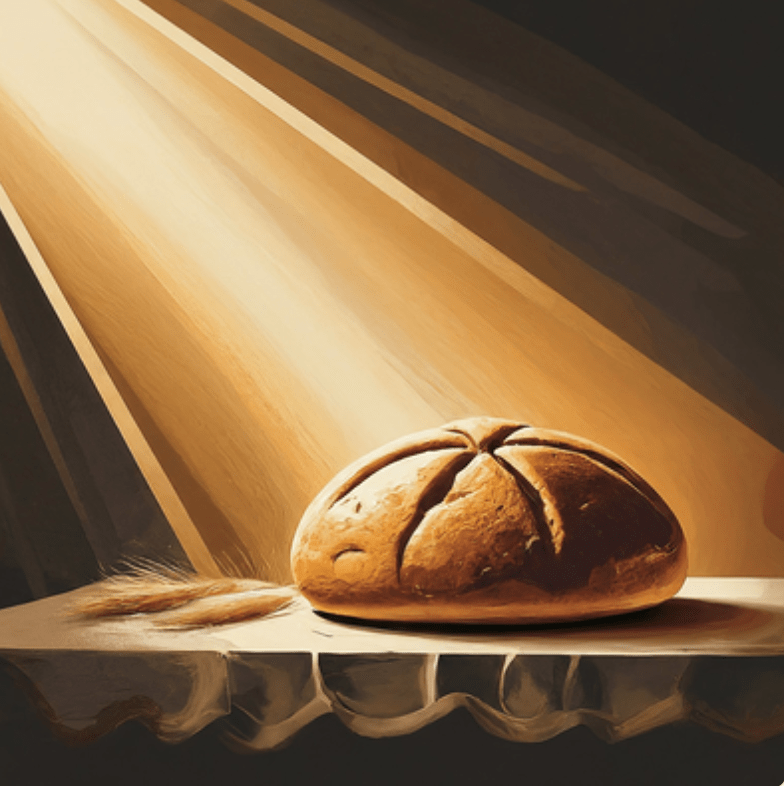
The Bread of the Presence, placed on the golden table inside the tabernacle, was a striking image of God’s provision. It was always there, a reminder that God sustains His people. But not just anyone could eat it. It was reserved for the priests, reinforcing the idea that communion with God’s provision was limited under the Old Covenant.
Then there was David, a man on the run, hungry and desperate. When he and his men arrived at the tabernacle, the priest gave them the Bread of the Presence. By law, this should have been off-limits (1 Samuel 21:1-6). But necessity outweighed the ritual. Jesus later pointed to this moment (Matthew 12:3-4), hinting that something much greater was coming. A time when God’s provision would no longer be reserved for a select few but given freely to all.
Christ, the Bread of Life
Centuries after David, Jesus fulfilled this and revealed its profound significance.
“I am the bread of life; whoever comes to me shall not hunger, and whoever believes in me shall never thirst.” (John 6:35)
Unlike the Bread of the Presence, which was set aside only for the priests, Jesus, the true Bread, is offered to everyone. His body is the ultimate provision, not just for physical sustenance but for eternal life.
On the night before His crucifixion, Jesus symbolically used bread to refer to His body. As He shared the Passover meal with His disciples, He took bread, blessed it, broke it, and gave it to them, saying:
“Take, eat; this is my body.” (Matthew 26:26)
The Bread of Life: Spiritual Nourishment in Christ
However, Jesus emphasized the spiritual nature of this nourishment. In John 6:63, He clarifies:
“It is the Spirit who gives life; the flesh is no help at all. The words that I have spoken to you are spirit and life.”
To “feed on Christ” means believing in His sacrifice, living according to His Word, and being transformed by His Spirit.
As Jesus stated in Matthew 4:4:
“Man shall not live by bread alone, but by every word that proceeds from the mouth of God.”
This nourishment is not physical but spiritual. Just as bread sustains the body, Christ’s Word sustains the soul. To partake in Him is to trust in His redemptive work and allow His Spirit to renew us.
Abiding in Christ: A Claim to Divine Authority
In the Old Testament, abiding in God was the condition for divine blessing (Psalm 91:1, Deuteronomy 30:20). Yet here, Jesus does not say, “If you abide in God,” but rather,
“If you abide in me, and my words abide in you, ask whatever you wish, and it will be done for you.” (John 15:7)
He places Himself as the source of divine life and power, something only God can claim. Further, the ability to grant whatever is asked belongs to God alone (Psalm 145:18-19). By making this promise, Jesus presents Himself not merely as a prophet of God, but as God Himself revealed in the flesh, the one who possesses divine authority.
This invitation to abide in Him reveals that Christ is not separate from the God who sustains and blesses, but is Himself the fulfillment of God’s presence among His people. This stands in stark contrast to the notion of multiple persons within the Godhead, affirming instead that the fullness of God is revealed in the person of Christ alone.
Breaking the Bread, Tearing the Veil
Then the moment of fulfillment arrived. Jesus was crucified. At that very moment, something earth-shattering happened.
“The veil of the temple was torn in two.” (Matthew 27:51)
For centuries, the Holy Place, where the Bread of the Presence was set, was separated by a veil. Only the high priest could pass through it, and only once a year. When Jesus died, the barrier was gone. The presence of God was no longer behind a curtain. Through Christ’s sacrifice, reconciliation with God is made available to all.
The Fulfillment of God’s Plan
From the tabernacle to the cross, God’s plan had always been the same.
- To dwell among His people
- To sustain them fully
- To bring restoration
The Bread of the Presence was a shadow of what was to come. The true Bread, Jesus Christ, is now freely given to those who hunger and believe.
As Jesus Himself said:
“The bread that I will give for the life of the world is my flesh.” (John 6:51)
This offering is not physical bread to be consumed but an invitation to receive His sacrifice and be nourished spiritually.
The Bread is no longer hidden behind the veil. It is now set before you. Will you partake?
The table is set, and the invitation is open. Come, eat, and live.
 Spread the Spirit
Share your thoughts!