

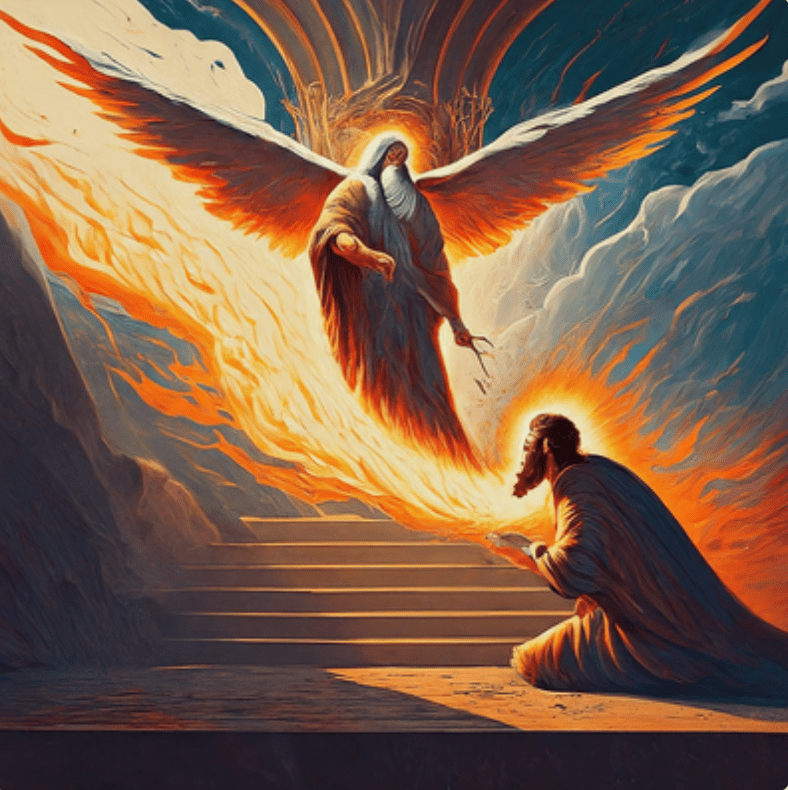
“Then the Lord put forth his hand, and touched my mouth. And the Lord said unto me, Behold, I have put my words in thy mouth.” – Jeremiah 1:9
🕊️ Isaiah’s Vision and the Cleansing of the Lips
In Isaiah 6, the prophet has a life-altering vision:
“In the year that King Uzziah died I saw also the Lord sitting upon a throne, high and lifted up, and his train filled the temple…” (Isaiah 6:1)
What follows is not only a glimpse of divine glory, but a dramatic moment of cleansing and commissioning. The focus of Isaiah’s transformation is surprisingly not his heart or his hands, but his lips.
When a burning coal from the altar touches his mouth, Isaiah is purified, forgiven, and immediately made ready to speak on behalf of God. What does this mean for us? And how does this strange act prefigure Christ’s work in us?
🔥 The Holy Touches the Unclean
Isaiah sees the Lord in a vision of holiness, surrounded by seraphim crying:
“Holy, holy, holy is the LORD of hosts: the whole earth is full of his glory.” (Isaiah 6:3)
Overwhelmed, Isaiah cries out:
“Woe is me! for I am undone; because I am a man of unclean lips, and I dwell in the midst of a people of unclean lips…” (Isaiah 6:5)
This confession is significant. Isaiah does not say “unclean heart” or “unclean thoughts,” but “unclean lips.” Why?
Because in God’s kingdom, the mouth is not just an instrument of communication, it is the channel through which truth, prophecy, praise, and life flow. Without purification, Isaiah is unfit to speak.
✝️ The Altar, the Coal, and the Atonement
A seraph flies to the altar, likely the altar of burnt offering, the place where sacrifices were made for atonement.
“Then flew one of the seraphims unto me, having a live coal in his hand, which he had taken with the tongs from off the altar: and he laid it upon my mouth…” (Isaiah 6:6–7)
This coal is born of sacrifice, glowing with fire. It represents not only purification but judgment that has already fallen, not on Isaiah, but on the offering.
The act is deeply symbolic:
“Lo, this hath touched thy lips; and thine iniquity is taken away, and thy sin purged.” (v. 7)
The burning coal from the altar points to Christ, who became both the offering and the altar (Ephesians 5:2; Hebrews 13:10). Taken from the place of sacrifice, this ember signifies the purifying fire of God’s presence. As it touched Isaiah’s lips and cleansed his iniquity, so does the living Word sanctifies all who draw near to Him. Christ is the divine flame that burns away sin and sets the soul apart for God.
🗡️ The Word as Fire
Scripture repeatedly describes God’s Word as fire:
- “Is not my word like as a fire? saith the Lord” (Jeremiah 23:29)
- “His word was in mine heart as a burning fire shut up in my bones…” (Jeremiah 20:9)
Christ Himself embodies this fire. His words are “spirit and life” (John 6:63) and “a sharp two-edged sword” (Hebrews 4:12). In Revelation, the risen Christ is portrayed with a sword proceeding from His mouth, a vivid image of the power of His Word to judge, pierce, and save.
When Jesus¹spoke to the disciples after His resurrection, the effect was undeniable:
“Did not our heart burn within us, while he talked with us by the way, and while he opened to us the scriptures?” (Luke 24:32)
His Word did not merely instruct. It kindled a flame within. It stirred the soul, awakening faith and understanding with divine intensity. Just as their hearts burned with revelation, so too did Isaiah encounter a holy fire that purified and prepared him to speak.
🔥 From Isaiah to Pentecost – Fire on the Lips
This encounter in Isaiah finds a striking parallel in the day of Pentecost:
“And there appeared unto them cloven tongues like as of fire, and it sat upon each of them. And they were all filled with the Holy Ghost…” (Acts 2:3–4)
Once again, fire touches the lips. But this time, the fire does not merely cleanse, it empowers. Isaiah was purified to speak to Israel. The disciples were filled to proclaim the Word to the nations.
In both moments:
- The mouth is central.
- The fire comes from God.
- The result is prophetic speech brought forth through divine cleansing.
📖 From God’s Word to Our Witness
From Genesis to Revelation, God works through speech:
- He creates by speaking (Genesis 1).
- He reveals through prophets.
- He saves through the spoken Gospel (Romans 10:14).
- And He judges with the sword of His mouth.
This is why the lips must be purified. The one who speaks for God must be sanctified by God. Our lips are not our own.
“Death and life are in the power of the tongue…” (Proverbs 18:21)
“Out of the abundance of the heart the mouth speaketh.” (Matthew 12:34)
🙌 Have Your Lips Been Touched by Fire?
Isaiah’s cleansing leads to a divine commission:
“Whom shall I send, and who will go for us?” Then said I, Here am I; send me.” (Isaiah 6:8)
He could not say “Send me” until the fire had touched his lips. Likewise, before we can speak boldly for Christ, our speech must be set apart, purged from lies, pride, and compromise.
So we must ask:
- Has the altar of Christ’s sacrifice touched our lips?
- Do our words reflect the fire of God’s Spirit or the impurity of this world?
- Are we ready to say: “Here am I, send me”?
🕊️ Purified to Proclaim: The Messenger’s Fire
The coal was not just hot, it was holy.
It was purification, not punishment.
And it did not silence Isaiah; it sent him.
Today, Christ still cleanses lips by His Word and fills mouths with fire by His Spirit. He still seeks messengers who have been purified at the altar of His cross and emboldened by the flame of His truth.
Let the Word touch your lips,
so the world may hear His voice.
 Spread the Spirit
Share your thoughts!