

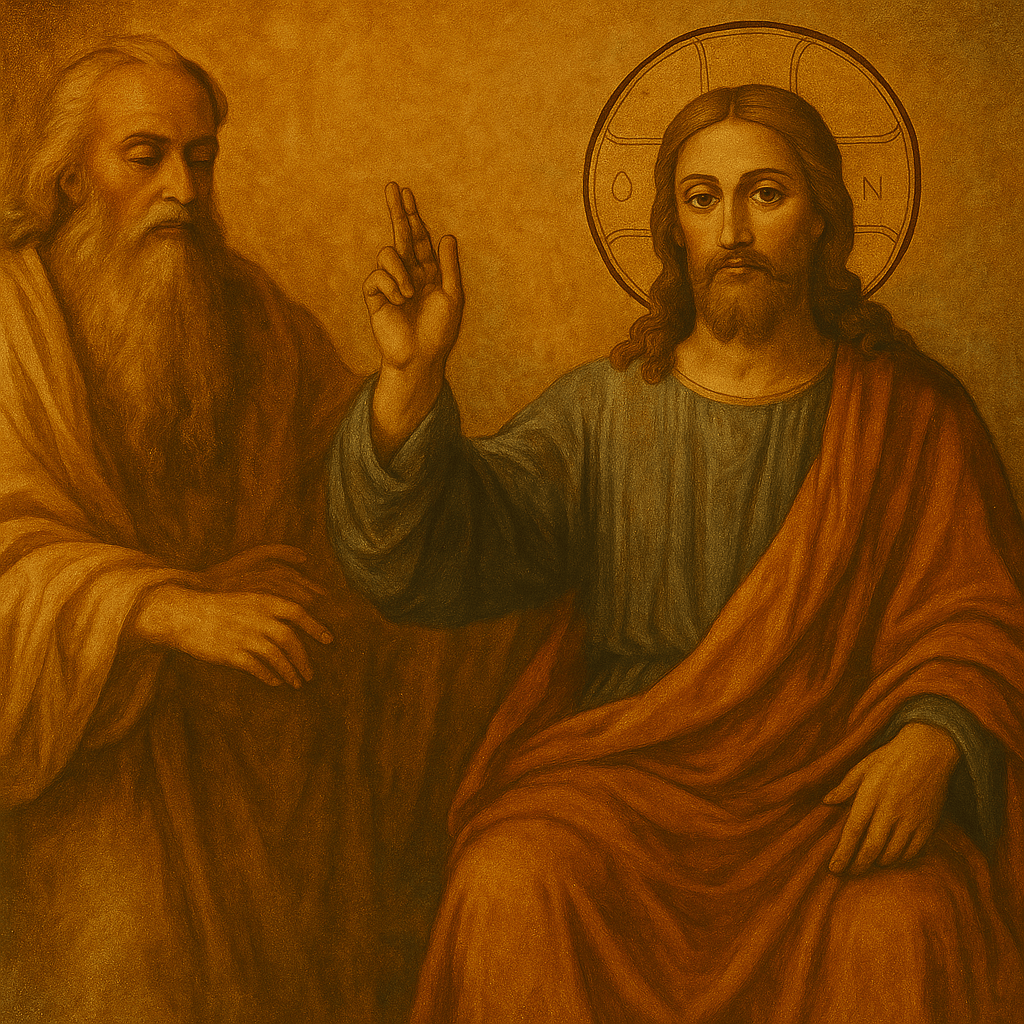
“And they worshipped him, and returned to Jerusalem with great joy.”— Luke 24:52
Reassessing the Right Hand of God in Light of Progressive Revelation
The question of whether the first Christians worshiped Jesus remains a pivotal fault line in theological debates. Scholars like James D.G. Dunn have argued that full-blown divine worship of Jesus was a later development, not the original posture of the early church. Dunn distinguishes between reverence and worship proper (latreia), asserting that only the Father received divine cultus, while Jesus was venerated as Messiah and exalted Lord. Dunn writes, “There is no indication that Jesus himself was ever the recipient of latreia in the New Testament.” (James D.G. Dunn, Did the First Christians Worship Jesus?, p. 15).
Such an argument collapses under close scriptural analysis and, more importantly, under the weight of canonical coherence. If the New Testament’s elevation of Jesus contradicts Old Testament monotheism, it must be rejected. But if it reveals the one God who previously concealed Himself, then worshiping Jesus is not an innovation. It is the culmination of what the prophets long foretold.
📜 Progressive Revelation Does Not Permit Theological Contradiction
At the heart of Dunn’s claim is an unspoken assumption: that the Church’s worship evolved without violating Old Testament boundaries. But if that evolution introduces contradiction, if the one God who forbade worship of any other now allegedly permits worship of a second person, then Scripture has disintegrated.
True revelation is progressive, not revisionist. It unveils God more clearly but never alters who He is. The Scriptures reveal God in stages, not by altering His essence, but by unfolding His self-disclosure from shadow to substance, from figure to fulfillment (Hebrews 10:1; Colossians 2:17).
The God who said, “I am the LORD, that is My name; My glory I give to no other” (Isaiah 42:8), cannot later say, “Share My glory with another divine being.” Scripture doesn’t change. As it is written, “The grass withers, the flower fades, but the word of our God shall stand forever” (Isaiah 40:8). Scripture doesn’t change. Either the worship of Jesus constitutes a theological rupture, or Jesus is the unveiled identity of that same indivisible God. He is not a second being, but the living Word made flesh.
✋ The Right Hand of God: Self-Revelation, Not Subordination
Much hinges on the biblical phrase “the right hand of God.” For Dunn and others, this denotes delegated authority, a seat of honor given to another beside God. However, in Scripture, the right hand is not a second being. It is a metaphor for God’s own action:
“Thy right hand, O LORD, is become glorious in power…” — Exodus 15:6
“His own arm brought Him salvation…” — Isaiah 59:16
This idiom never implies a second divine person. The right hand is not beside God. It is God made visible. So when Jesus is said to be seated at the right hand, Scripture is not describing a newly exalted partner. It is the public enthronement of the very God who once dwelt in darkness, as Solomon declared, “The LORD has said that he would dwell in thick darkness” (1 Kings 8:12; 2 Chronicles 6:1).
✝️ Stephen’s Vision: The Worship of Jesus Under Fire
One of the clearest New Testament moments of Christ-worship occurs in Acts 7, where Stephen, filled with the Holy Spirit, sees Jesus standing at the right hand of God and prays:
“Lord Jesus, receive my spirit.” — Acts 7:59
This echoes Psalm 31:5, where David addresses YHWH: “Into Your hand I commit my spirit.” Stephen, like Jesus before him (Luke 23:46), invokes God in the moment of death. But after the resurrection, Stephen does not address the Father. He addresses Jesus.
This is not prayer through Jesus. This is prayer to Him. It is worship of the crucified and risen One as the visible expression of God’s right hand.
👑 Philippians 2: Isaiah’s Monotheism, Revealed in Christ
Dunn argues that Philippians 2 presents Jesus as exalted due to obedience, not identified as divine. But the text itself contradicts this.
“At the name of Jesus every knee should bow… every tongue confess that Jesus Christ is Lord…” — Phil 2:10–11
This is a direct quotation of Isaiah 45:23, where YHWH swears that every knee will bow to Him alone. Paul’s use of this text is not arbitrary. It is explosive. The worship that Isaiah reserves for YHWH is now rightfully rendered to Jesus.
Jesus does not replace YHWH. He reveals Him. The one to whom every knee should bow is the one God Israel has always known, now bearing a human name.
🔦 Revelation 5: Worship without Distinction
Revelation 5 culminates in one of the most unambiguous worship scenes in Scripture:
“To Him who sits on the throne and to the Lamb be blessing and honor and glory and might forever and ever.” — Rev 5:13
If Jesus is not God, then this is idolatry. But if the Lamb is the arm of the LORD made visible (Isaiah 53:1), then this is the natural climax of divine revelation. There are not two divine beings on a shared throne, but one God revealed. The Lamb is not beside the One on the throne; He is the manifestation of the One who sits upon it. To worship the Lamb is to worship God revealed in flesh.
There is no division in divine glory. Authority flows from a singular throne, and the worship offered is united, directed toward one revealed presence. The fullness of God’s identity now stands unveiled in the risen Christ.
✨ From Gospels to Glory: Christ Revealed
The worship of Christ in the Gospels is not premature or mistaken; it is the only fitting response to the One in whom the right hand of God is revealed. The Scriptures declare that the right hand of the LORD shatters enemies (Exodus 15:6), works salvation (Psalm 98:1), upholds the righteous (Isaiah 41:10), and is exaltated in victory (Psalm 118:16). This right hand, once spoken of in figures and visions, is now made flesh in Jesus Christ. When He heals the leper, calms the storm, forgives sins, and casts out demons, He performs what only the hand of God can accomplish.
Further, Jesus fulfills what Psalm 107 describes of the LORD Himself: “Then they cried to the LORD in their trouble, and he delivered them from their distress. He made the storm be still, and the waves of the sea were hushed.” The disciples cry out in fear during the storm, and Jesus calms the sea. The leper pleads on his knees, and he is made clean. The blind man cries out for mercy, and he receives his sight. Each one cries to the Lord in their trouble, and He answers with deliverance. The leper kneels, the disciples worship after the sea is stilled, and the blind man confesses Him. These are not isolated incidents. They are glimpses into the unveiled mystery that Jesus is the manifestation of divine power. To worship Him is not to divert glory from God but to recognize that God’s presence, and salvation have appeared in Him.
The worship rendered to Jesus is not a departure from Jewish monotheism but its fulfillment. It is the recognition that the God who once dwelt in unapproachable light has now drawn near in the person of His Son. Psalm 118 declares that the right hand of the LORD is exalted, and this finds its ultimate fulfillment in the resurrection, when Christ is raised in victory and seated in glory. The one who was rejected has become the cornerstone. His exaltation is not a new elevation but the divine vindication of the right hand of God.
📖 The One Worshiped from Beginning to End
From Genesis to Revelation, the biblical story remains anchored in one truth: there is only one God, and He alone is worthy of worship. What the early Christians confessed about Jesus was not an innovation but a recognition. The worship rendered to Him was not a deviation from monotheism but its fulfillment. They saw in the risen Christ the very glory that once filled the tabernacle and temple, the same glory that descended in darkness at Sinai and rose in triumph from the grave.
To worship Jesus was not to divide God’s identity. It was to behold the God who had always revealed Himself in veiled majesty, now unveiled in the person of His Son.
Progressive revelation is not contradiction. It is the lifting of the veil.
Jesus is the right hand made visible, the Name confessed, the One to whom every knee will bow.
 Spread the Spirit
Share your thoughts!