

“He saw that there was no man, and wondered that there was no one to intercede; then His own arm brought Him salvation, and His righteousness upheld Him.” – Isaiah 59:16
This post argues that Paul’s Damascus encounter reveals Jesus as the embodied “arm of YHWH,” thereby fulfilling the Shema rather than violating it.
The Arm Revealed: Prophecy and Fulfillment
Isaiah’s vision of YHWH’s solitary intervention sets the theological foundation. God Himself would bring salvation, unaided by human intercessors. This prophetic expectation finds its historical fulfillment not in a generic messianic figure, but in the risen Christ whom Paul encounters. What is revealed is not a delegated agent, but the very glory of YHWH.
Second-Temple literature distinguishes between authorized agents (shaliach) who bear God’s name functionally, and the unique divine identity itself. Paul’s claim places Jesus in the latter category. Some Second-Temple voices, such as 1 Enoch 48, imagined a distinct heavenly figure, yet rabbinic reaction labeled this “two powers” heresy. Paul’s vision collapses any such duality by equating Christ with YHWH’s own glory.
For comparison, Wisdom of Solomon 18:15–16 describes God’s Word as a mighty envoy, “leaping from heaven,” but it remains distinct from God’s own identity. Paul’s Damascus encounter, however, does not describe an emissary. It presents the radiant disclosure of God’s very self.
The Incarnate Arm: Mary’s Song and Israel’s Hope
Mary’s Magnificat draws deeply from the prophetic tradition, echoing Hannah’s song in 1 Samuel 2:1–10. Her words anticipate not merely a personal blessing, but a cosmic reversal through divine intervention.
“He has shown strength with His arm… He has helped His servant Israel… as He spoke to our fathers.” (Luke 1:51, 54–55)
Her declaration aligns Jesus with the long-anticipated arm of the LORD, not as a metaphor but as incarnate reality. The redemptive power long awaited by Israel now takes form in her womb. What was once sung in psalm and prophecy has become embodied.
The Right Hand in the Psalms
In the Psalms, the right hand of YHWH never denotes a subordinate figure. It refers consistently to God’s own saving presence:
- “The right hand of the LORD is exalted…” (Psalm 118:16)
- “He stands at the right hand of the needy…” (Psalm 109:31)
- “Because He is at my right hand, I shall not be shaken.” (Psalm 16:8)
These texts speak of nearness, advocacy, and power. To stand at someone’s right hand is not a sign of subordination but of divine intervention. The earliest believers saw in Jesus not an angelic proxy but the embodied presence of YHWH’s own right hand.
Stephen’s Vision: Royal and Redemptive
As Stephen dies, he declares:
“Behold, I see the heavens opened, and the Son of Man standing at the right hand of God.” (Acts 7:56)
This vision fuses Psalm 110:1 (“Sit at my right hand…”) with Psalm 109:31 (“He stands at the right hand of the needy”), linking Christ’s enthronement with His advocacy.
Luke’s juxtaposition ties Christ’s standing in defense (Psalm 109:31) to His royal enthronement (Psalm 110:1), two roles Judaism reserved for YHWH alone. Stephen sees Jesus not as subordinate but as divine Judge and Advocate.
Saul the Zealot: Hardened Against the Glory
Saul does not witness Stephen’s vision, nor is he said to have heard his confession. He holds the coats of those who kill the seer, complicit but blind. His zeal for the Shema renders him incapable of imagining that the crucified Jesus could bear the divine Name. Revelation is withheld. His heart remains veiled.
What Stephen saw in death, Paul would behold in blinding light.
The Damascus Theophany: Divine Encounter
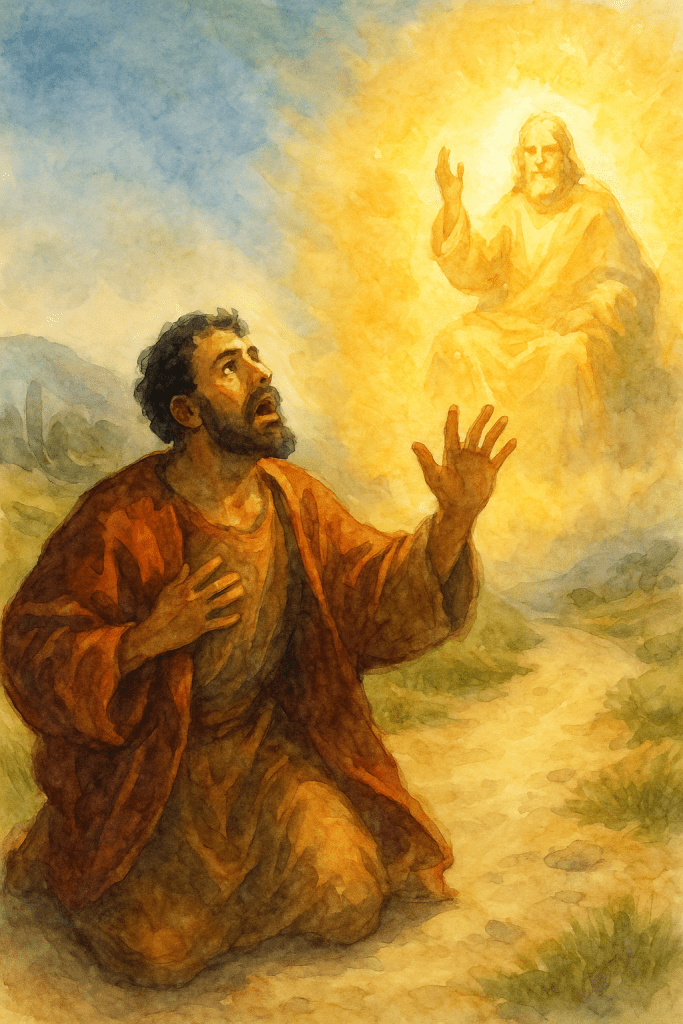
“Suddenly a light from heaven flashed around him… He fell to the ground and heard a voice: ‘Saul, Saul, why are you persecuting Me?’” (Acts 9:3–4)
Acts 9 mirrors classical theophanies. The brilliance recalls Ezekiel 1 and Daniel 10. The personal address echoes Exodus 3. Saul’s collapse resembles the prophetic falls of Isaiah and Daniel.
The heavenly voice speaks plainly: “I am Jesus.” No second being appears. The crucified one is now radiant with divine glory, bearing the authority and Name of YHWH. This public theophany is not a mystical impression but a historical confrontation. The arm of YHWH does not send a servant; it arrives. Christ is not beside God. He is God revealed in salvific power.
The Shema Reinterpreted in Christ
Paul would later reinterpret this event not as private mysticism but as divine revelation:
“God… has shone in our hearts to give the light of the knowledge of the glory of God in the face of Jesus Christ.” (2 Corinthians 4:6)
This is no metaphor. The light is uncreated. The glory is not secondary. In Jesus, Paul beheld the radiance of YHWH.
This understanding is not a novelty but reflects the central claim of early high Christology. As Richard Bauckham explains:
“Jesus is included in the unique divine identity, which for Second Temple Jews was the distinguishing feature of the one true God.”¹
This is why Paul reconfigures the Shema in 1 Corinthians 8:6:
“For us there is one God, the Father… and one Lord, Jesus Christ…”
This is not theological dualism. It is the outworking of divine revelation. Christ is not separate from God but the divine Word made manifest.
The Apostolic Confession: Scripture Applied to Christ
Paul applies Old Testament texts about YHWH directly to Jesus:
- Joel 2:32 → Romans 10:13 (“Everyone who calls on the name of the Lord”)
- Isaiah 45:23 → Philippians 2:10–11 (“Every knee will bow…”)
- Psalm 110:1 → 1 Corinthians 15:25 (“He must reign until…”)
For discussion, see Larry Hurtado, Lord Jesus Christ, 2003, pp. 141–48.
Even Ignatius of Antioch, writing around 110 CE, confesses “our God, Jesus the Christ” (Ephesians 18:2). The earliest post-apostolic voices did not hesitate to confess Jesus within the divine identity.
The Arm Bared, the Name Revealed
Isaiah’s promise is fulfilled:
“The LORD has bared His holy arm in the sight of all the nations, and all the ends of the earth shall see the salvation of our God.” (Isaiah 52:10)
That arm, once stretched forth in deliverance, now bears cruciform scars and the name Jesus. The very name means “The LORD saves,” revealing not just what God has done, but who He is. The glory that once descended on Sinai in fire and cloud now shines from the face of the risen Christ. What Paul once condemned as blasphemy, he came to proclaim as divine revelation. The right hand of the LORD is no longer a poetic metaphor. It is God revealed in the person of Christ. The Arm has been bared. The Name has been revealed. Jesus is the salvation of our God.
References
- Richard Bauckham, Jesus and the God of Israel: God Crucified and Other Studies on the New Testament’s Christology of Divine Identity (Grand Rapids: Eerdmans, 2008), 40.
- For related OT-to-NT text transfers and their theological implications, see Larry W. Hurtado, Lord Jesus Christ: Devotion to Jesus in Earliest Christianity (Grand Rapids: Eerdmans, 2003), 141–48.
 Spread the Spirit
Share your thoughts!