

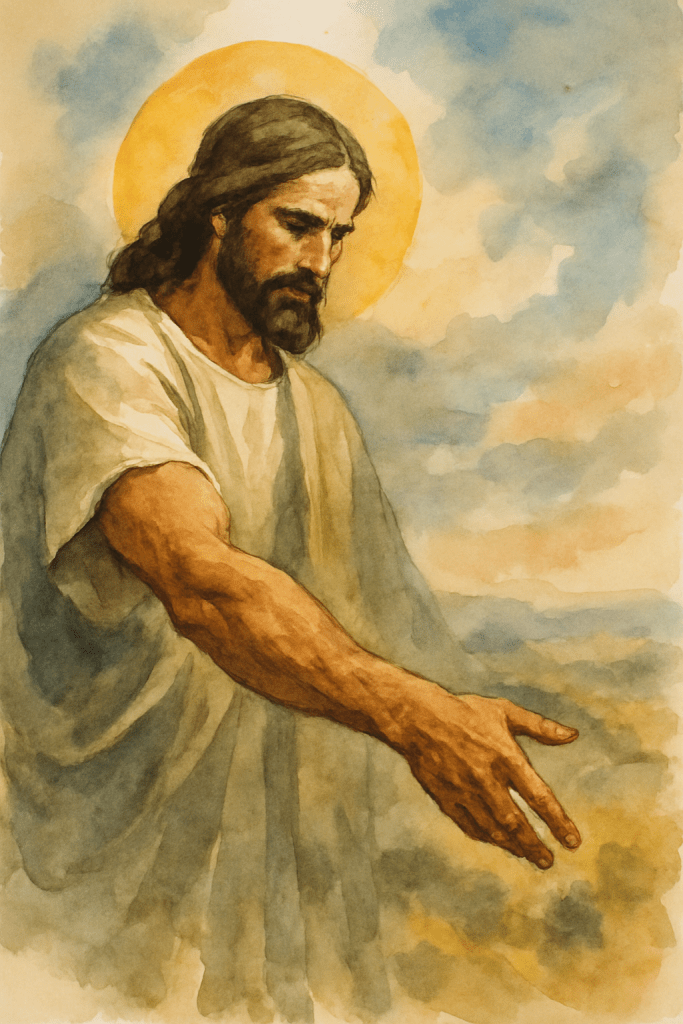
“And I looked, and there was none to help; and I wondered that there was none to uphold: therefore mine own arm brought salvation unto me…”
— Isaiah 63:5
Christology Without the Arm
The Hebrew Bible frequently employs embodied metaphors to articulate divine agency. Among these, the phrase “the arm of the LORD” stands as one of the most potent and recurrent symbols of God’s saving power. Yet by the second century, this biblical metaphor had nearly disappeared from theological discourse. This loss carried significant doctrinal implications.
Far from inviting anthropomorphic speculation, the arm metaphor conveys divine immediacy. It signifies God acting in history without mediation or delegation. The arm is not symbolic force; it is God’s own presence made visible.
This imagery reaches its theological climax in Isaiah’s Servant Songs. Isaiah 52:10 declares, “The LORD has bared His holy arm before all nations,” and Isaiah 53:1 asks, “To whom has the arm of the LORD been revealed?” The New Testament later answers this through the Gospel of John, which explicitly links Jesus to this prophetic question and identifies Him as the revealed arm of God.
Yet within the corpus traditionally known as the Apostolic Fathers, this metaphor vanishes. Although these early Christian writers affirm the divinity of Christ and draw deeply from the Old Testament, they never apply “the arm of the LORD” to His role in redemption. This is not merely an omission. It signals an emerging theological posture in which embodied biblical language was quietly set aside in favor of conceptual formulations shaped by Hellenistic philosophy.
Rather than developing Christology through biblical idioms such as arm, hand, voice, and presence, early post-apostolic theology increasingly turned to terms like ousia (substance), hypostasis (person), and eternal generation. A metaphor grounded in unified divine action became progressively incompatible with a model structured around triadic relations and metaphysical procession.
This post argues that the neglect of the arm metaphor was not an exegetical oversight but a theological loss. What disappeared was a scriptural idiom that testified to God’s own undivided self-revelation. To rediscover the “arm of the LORD” is to recover a theological vision where redemptive power belongs to God Himself, manifested in Jesus Christ.
The Arm in the Prophets and Apostles
The Hebrew Scriptures consistently describe God’s redemptive activity using the language of the arm:
- “With a mighty hand and an outstretched arm” (Deuteronomy 5:15)
- “His own arm brought Him salvation” (Isaiah 59:16)
- “His right hand and His holy arm have worked salvation” (Psalm 98:1)
These are not literary ornaments but theological affirmations. The arm is God’s personal intervention, not the work of a second person but the manifestation of the LORD Himself.
The New Testament intensifies this claim. John 12:38 quotes directly from Isaiah 53:1, saying:
“Lord, who hath believed our report? And to whom hath the arm of the Lord been revealed?”
This citation comes immediately after John recounts the signs performed by Jesus, identifying Him as the very fulfillment of Isaiah’s prophetic question. The implication is clear: the long-concealed arm of the LORD has now appeared in Christ.
In Him, the unseen power of YHWH becomes visible, embodied, and historically active.
The Apostolic Fathers and the Silent Arm
Writers such as Clement of Rome, Ignatius of Antioch, and the author of the Epistle of Barnabas demonstrate reverence for the Old Testament and a high view of Christ. They refer to Christ as “our God” (Ignatius, Eph. 1) and use rich theological vocabulary for the cross and resurrection. Yet despite the prominence of Isaiah 53 in early Christian preaching, none applies the “arm of the LORD” to Jesus.
This silence cannot be attributed to ignorance. It reflects a transition from prophetic idiom to philosophical ontology, a reorientation away from embodied categories of divine agency. While these authors uphold the authority of Scripture, they depart from the revelatory tradition that shaped Israel’s understanding of divine action. The scriptural pattern of unmediated redemption, in which God Himself acts, was gradually replaced by abstract formulations that accommodated ontological hierarchy and mediated agency.
From Prophetic Metaphor to Philosophical Abstraction
As J. N. D. Kelly observes, the post-apostolic period saw a migration from Hebraic categories to Hellenistic ones (Kelly 1978, 76–78). God was no longer described by active, embodied metaphors like hand, breath, or voice, but through metaphysical terms such as essence, substance, and person.
In this conceptual shift, “the arm of the LORD” became theologically inconvenient. It presumes decisive engagement, historical intervention, and unified divine agency. These implications clashed with emerging theological frameworks that emphasized eternal processions, relational distinctions, and the impassibility of God.
What Was Gained and Lost
The adoption of metaphysical categories during the post-apostolic period brought theological benefits. Faced with the rise of doctrinal error and the challenge of explaining divine mystery to a Hellenized world, early Christian thinkers found clarity in the language of essence, person, and relation.
What Was Gained:
- Clarity and Definition: Terms such as ousia (substance) and homoousios (of one substance) helped articulate the full divinity of Christ, offering precise language to counter Arianism and other heresies (Ayres 2004, 251).
- Philosophical Universality: Hellenistic thought provided a common intellectual framework through which Christian doctrine could engage the broader Greco-Roman world (Behr 2001, 208).
- Doctrinal Stability: The metaphysical formulations of Nicaea and subsequent councils offered lasting theological structure for the doctrine of the Trinity and the person of Christ (Anatolios 2011, 143–145).
Yet these gains came at the cost of a theological immediacy that had characterized the Hebrew Scriptures.
What Was Lost:
- Narrative Immediacy: The Old Testament’s vivid portrayal of God acting personally and directly in history was gradually eclipsed by abstract models of divine processions and eternal generation (Young 1997, 94–96).
- Scriptural Language: Prophetic metaphors such as the arm, hand, breath, and voice of the LORD were sidelined in favor of ontological categories that lacked the same experiential resonance (Williams 2001, 78).
- Experiential Connection: The metaphor of the arm conveyed God’s own intervention, not merely an instrument of action. Its marginalization weakened the sense of God’s nearness and singular agency in redemptive history.
The Broader Patristic Context
Although the Apostolic Fathers seldom employed the arm metaphor, some later patristic writers made limited efforts to preserve biblical imagery. Athanasius, for instance, occasionally spoke of the Son as the Father’s hand or power, using such terms to affirm His consubstantiality. Cyril of Alexandria similarly used these metaphors to reinforce Christ’s unity with the Father. However, these references were always nested within metaphysical frameworks, never allowed to carry theological weight on their own (Anatolios 2011, 149; Ayres 2004, 252).
Such usage was rare. The dominant pattern in patristic theology was to subordinate scriptural metaphors to philosophical explanation. As Frances Young observes, early Christian theology increasingly “translated biblical imagery into conceptual categories,” sacrificing literary immediacy for doctrinal uniformity (Young 1997, 95).
The metaphor of the arm, with its emphasis on God’s undivided action in history, was incompatible with frameworks that emphasized relational distinctions and mediated agency. Rather than being rejected outright, it was rendered theologically inconvenient.
This silence, therefore, was not benign. It reflects a redirection of theological instinct. The grammar of Scripture was not denied but quietly sidelined. What was gained in metaphysical precision came at the expense of the prophetic witness to God’s direct involvement in salvation.
The Displacement of the Arm: Ontology over Intervention
Rowan Williams has noted that early theological debates were shaped by the need to preserve divine transcendence within a Hellenistic worldview (Williams 1987, 40–45). Arius, for example, proposed a created intermediary to safeguard God’s unchangeability while still allowing Him to act in creation.
In this context, even when the “arm” metaphor remained in vocabulary, it lost its original force. It came to denote delegated function rather than direct presence.
The Nicene Creed did not return to prophetic imagery but instead formalized metaphysical definitions. The Son was confessed homoousios (of one substance) with the Father, and theological focus turned to eternal relations within the Godhead. As Lewis Ayres observes, these categories emphasized ontological parity while sidelining the redemptive narrative of Scripture. (Ayres 2004, 252–55).
The cost of this development was the displacement of a biblical idiom of divine action. The metaphor of the arm had been obscured beneath layers of ontological abstraction.
The Arm Revealed: God Acts Alone
“To Whom Has the Arm Been Revealed?”
Jesus said that He does nothing of Himself but only what He sees the Father doing. This is not a claim of subordination. It is a declaration of unified identity. He is both the Word spoken and the Arm stretched forth. He is the utterance and the execution. What God promised, He performed in Christ.
“Awake, awake, put on strength, O arm of the LORD. Awake, as in the days of old, the generations of long ago. Was it not You who cut Rahab in pieces, who pierced the dragon?” (Isaiah 51:9)
The cry in Isaiah 51 is not for a servant or a messenger. It is for the arm of God Himself to rise again in power, as in the days of Egypt. The arm is not another. The arm is God in action. He alone triumphed over chaos. He alone redeemed His people.
This image stands at the heart of biblical revelation. God does not deliver through delegation. He intervenes personally. The metaphor of the arm affirms that God Himself has entered history, not through a lesser being but in His own power. The redemptive work of Christ is the direct action of the one true God
Its absence in the Apostolic Fathers is not accidental. It reflects a theological redirection in which metaphors of divine agency were displaced by ontological categories. The cost was significant: a vision of divine immediacy gave way to abstraction.
To retrieve the arm is not merely to recover a metaphor. It is to reclaim the truth that God did not send another. He came Himself, and His name is Jesus.
References
- Anatolios, Khaled. Retrieving Nicaea: The Development and Meaning of Trinitarian Doctrine. Grand Rapids: Baker Academic, 2011, pp. 140–155.
- Ayres, Lewis. Nicaea and Its Legacy. Oxford: Oxford University Press, 2004, pp. 251–255.
- Behr, John. The Way to Nicaea. Crestwood, NY: St. Vladimir’s Seminary Press, 2001, pp. 203–210
- Kelly, J. N. D. Early Christian Doctrines. 5th ed. London: A & C Black, 1978, pp. 76–78.
- Williams, Rowan. Arius: Heresy and Tradition. Rev. ed. London: Darton, Longman & Todd, 1987, pp. 40–45; 73–105.
- Young, Frances M. Biblical Exegesis and the Formation of Christian Culture. Cambridge: Cambridge University Press, 1997, pp. 92–103.
 Spread the Spirit
Share your thoughts!