

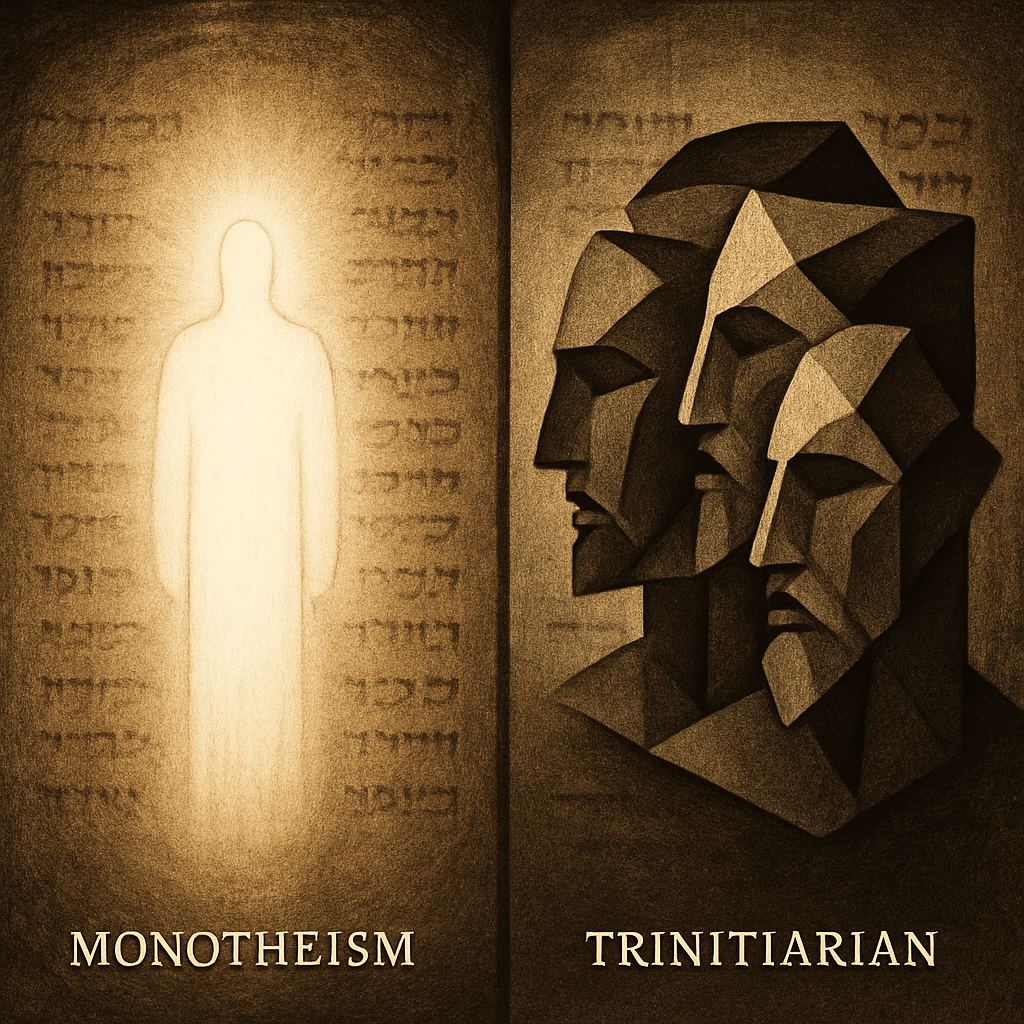
A Modern Distortion
In the latter half of the twentieth century, Trinitarian theology experienced significant renewal and reevaluation, largely through the work of prominent theologians such as Karl Barth, Karl Rahner, John Zizioulas, Jürgen Moltmann, and Wolfhart Pannenberg. This movement shifted the Trinity from being a peripheral doctrine to the very center of Christian theology, with far-reaching implications for how Christians think about God, community, worship, and even ethical and political life.
Yet this movement is not a return to the teaching of the prophets and apostles. It is a modern innovation, a theological infiltration that distorts the very foundation it claims to recover. The so-called Trinitarian revival rests on speculative philosophy, ontological constructs, and abstract conceptual frameworks foreign to the biblical text. What is presented as a recovery is, in reality, a systematic departure from the foundational truth: God is one, undivided in person or relation.
This post seeks to show, from Scripture alone, that the modern reinterpretation of the Trinity is inconsistent with biblical monotheism and incompatible with the testimony of Christ and His apostles.
The Collapse of Simplicity
Karl Barth argued that “God’s being is His act,” claiming God elects Himself to be the Savior in and through Jesus Christ. For Barth, the eternal Son has no reality apart from the incarnate Jesus, in whom God’s self-revelation is fully realized. This approach erases the boundary between eternity and history, confusing the Creator with creation and making God defined by historical events rather than by His eternal nature
Rahner’s maxim, “the economic Trinity is the immanent Trinity,” collapses any real distinction between God’s eternal being and His actions in salvation history. In this view, historical events become intrinsic to God’s being and identity, making God dependent on human affairs for His own self-definition.
Zizioulas advanced the idea that God’s very being is relational, defined by the Father’s begetting of the Son and spirating of the Spirit. Divine substance, then, does not exist apart from these interpersonal actions. Such a model risks reducing God to a divine society of mutually dependent persons, rather than maintaining His indivisible unity.
Moltmann, for his part, moves the suffering of Christ from the realm of history into the very life of God. The crucifixion becomes not merely an act of God, but an event within God Himself, rendering the eternal God subject to temporal change and suffering. In this view, God ceases to be unchanging and is shaped and defined by temporal experience.
These are not refinements of biblical teaching, but philosophical revisions that present, ultimately, a different God altogether.
What the Bible Actually Teaches
Trinitarians often appeal to passages like the baptism of Jesus (Matthew 3:16–17), the Great Commission (Matthew 28:19), and Jesus’ prayer in John 17 as evidence of plurality within the Godhead. However, these texts can also be read as distinguishing between God in His transcendent nature and God manifested in the flesh. When Jesus prays, He does so not as a second divine person, but as the human vehicle for God’s redemptive purpose. Similarly, the Spirit’s descent is not the indication of a separate mind, but a visible expression of God’s anointing upon His servant. Such passages demonstrate the relationship between God and His human manifestation, rather than interaction among separate divine persons.
The Bible often speaks in relational, dynamic, and sometimes dialogical terms. For example, Jesus speaks to the Father and the Spirit descends. Such expressions do not point to internal divisions within God’s being, but rather reveal God’s redemptive activity in human history. Scripture communicates God’s work through narrative rather than through abstract metaphysical concepts. When rightly understood, the relational language of the Bible affirms, rather than undermines, the unity of God.
God is One
- “Hear, O Israel: The LORD our God, the LORD is one.” (Deuteronomy 6:4)
- “I am the first and I am the last; besides me there is no god.” (Isaiah 44:6)
- “Before me no god was formed, nor shall there be any after me. I, even I, am the LORD, and besides Me there is no savior.” (Isaiah 43:10–11)
- “Have we not all one Father? Has not one God created us?” (Malachi 2:10)
- “I am God, and there is no other; I am God, and there is none like me.” (Isaiah 46:9)
- “But He is of one mind, and who can turn Him?” (Job 23:13)
The unity of God is not abstract or relational. It is absolute. There is no division, no complexity of persons, and no internal distinction within His being.
God Acts Alone
- “I looked, but there was no one to help… so my own arm brought me salvation.” (Isaiah 63:5)
- “God was manifest in the flesh.” (1 Timothy 3:16)
- “Whoever has seen me has seen the Father.” (John 14:9)
- “For in Him dwells all the fullness of the Godhead bodily.” (Colossians 2:9)
God does not share His glory or agency with multiple persons. The Bible presents one God who reveals Himself directly. Jesus is not a second person. He is the full and visible manifestation of the one invisible God.
The Apostles Knew No Trinity
- “God has made this Jesus, whom you crucified, both Lord and Christ.” (Acts 2:36)
- “Yet for us there is one God, the Father… and one Lord, Jesus Christ…” (1 Corinthians 8:6)
These statements uphold the Shema. They do not introduce divine persons. Jesus is the Lord precisely because He is the one God revealed in flesh.
God Does Not Change
- “I the LORD do not change.” (Malachi 3:6)
- “Jesus Christ is the same yesterday and today and forever.” (Hebrews 13:8)
The claim that God is shaped by history or suffering contradicts these clear affirmations. Scripture stands upon God’s unchanging nature.
A God Who Grieves for a Reason
Modern theologians often treat divine emotion as internal relational drama within the Trinity. They imagine God grieving within Himself, as one person relating to another. But Scripture gives no support for this.
In Genesis 6, we are told:
- “The LORD saw that the wickedness of man was great in the earth, and that every intention of the thoughts of his heart was only evil continually. And the LORD regretted that He had made man on the earth, and it grieved Him to His heart.” (Genesis 6:5–6)
The reason for this grief is immediately clear: unrelenting human wickedness. The text continues:
- “The earth was corrupt in God’s sight, and the earth was filled with violence.” (Genesis 6:11)
- “All flesh had corrupted their way on the earth.” (Genesis 6:12)
- “The sons of God saw that the daughters of man were attractive. And they took as their wives any they chose.” (Genesis 6:2)
The context reveals moral degeneration, the breakdown of divine order, and the spread of violence. God grieves not as one person in fellowship with others, but as the holy Creator responding to sin. His grief leads to judgment, not introspective sorrow. His emotions are covenantal and moral, always directed toward His creation.
The Cost of This Theology
When modern theologians redefine God’s being as constituted by eternal relations, they undermine Scripture’s consistent witness that God is self-existent and indivisible. When they interpret divine sorrow or suffering as events within God’s inner life, they ignore that biblical grief is always in response to humanity, not within God Himself. To assign volition, consciousness, and identity to multiple divine persons is to abandon the biblical simplicity and sovereignty of the one LORD.
These models do not preserve Christian doctrine. They replace it. What emerges is no longer the God of Abraham, Isaac, and Jacob. It is a concept molded to fit relational and psychological categories, not the revelation given through the prophets and apostles.
A Call to Return
The God of the Bible is not a tri-personal being. He is the one LORD who created the heavens and the earth, who revealed Himself to Abraham, spoke through the prophets, and made Himself known in Jesus Christ. His Word is not another person. His Spirit is not a distinct mind. These are expressions of the same indivisible God.
“Stand at the crossroads and look. Ask for the ancient paths, ask where the good way is, and walk in it.”
Jeremiah 6:16
We must return to the simplicity of Scripture. Not to the scaffolding of human systems. Not to the abstractions of metaphysical philosophy. But to the One who is, who was, and who is to come. The Almighty.
To embrace the modern doctrine of the Trinity is not to deepen the faith delivered to the saints. It is to substitute it with a structure built on speculative theology. The God revealed in Scripture is singular. His name stands above every name. There is none beside Him. (Deuteronomy 32:39).
References
- Karl Rahner, The Trinity
- Jürgen Moltmann, The Trinity and the Kingdom of God
- John D. Zizioulas, Being as Communion
- David K. Bernard, The Oneness of God
- James D. G. Dunn, Did the First Christians Worship Jesus?
 Spread the Spirit
Share your thoughts!