

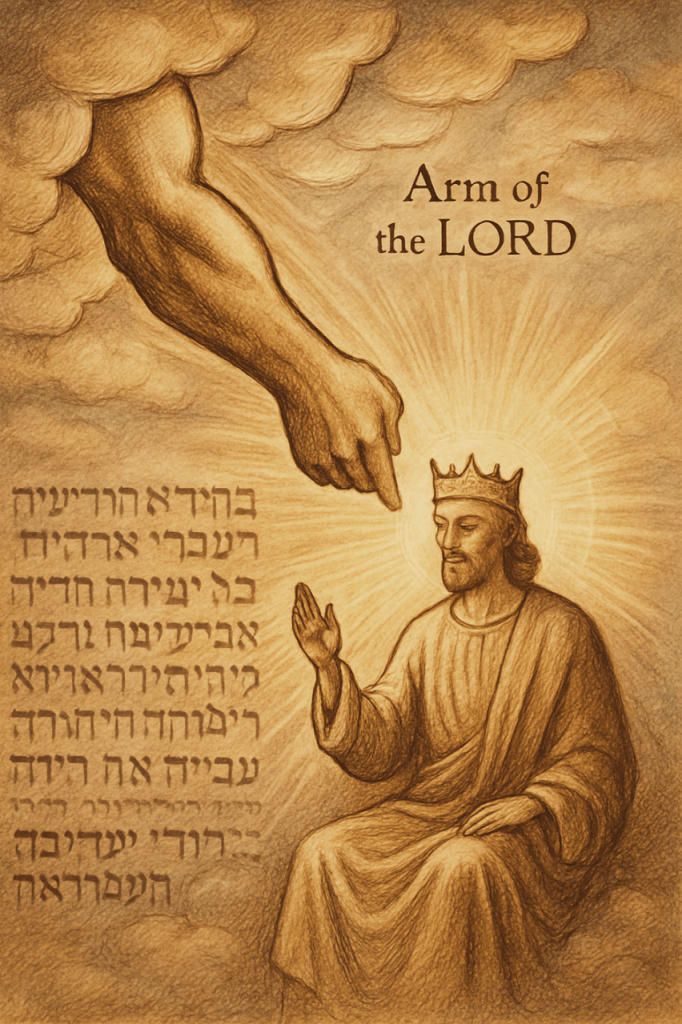
“For whoever finds me finds life and obtains favor from the LORD.” — Proverbs 8:35
Reclaiming the Unity of God in Biblical Language
Early Christian theologians often read Old Testament passages as proving distinctions within God, supporting the emerging doctrine of the Trinity. However, these interpretations frequently relied on allegory or later doctrinal categories, slipping away from the historical and literary context of the Hebrew Scriptures.
This post returns to the original scriptural logic, arguing that key biblical texts do not point to intra-divine persons but consistently testify to the singular agency of the LORD, whose wisdom and power are expressed in history, especially in Jesus Christ. The Bible identifies ‘the Arm of the LORD‘, not a triune deity, as the central metaphor for God’s redemptive disclosure in Christ.
Lady Wisdom: Personification, Not Pre-Existence
Proverbs 8:22 (“The LORD created me at the beginning of his work”) and Wisdom of Solomon 7:25 (“a reflection of eternal light”) have long been cited as evidence for the pre-existence of Christ as the Logos.
However:
- In context, “Wisdom” is a poetic personification. She is not a distinct divine being but a vivid way to speak of God’s creative and saving power.
- Proverbs teaches that to seek Wisdom is to seek the way of the LORD, not to uncover metaphysical distinctions inside God.
- Jewish readers of the time understood Wisdom not as an eternal second person but as an attribute or manifestation of God active in creation, a view consistently reflected throughout Second Temple literature.
In the New Testament, Paul calls Jesus “the wisdom of God” (1 Corinthians 1:24), showing that Jesus embodies divine wisdom within the framework of redemptive history, not as a pre-existent divine being.
Takeaway: The early church’s move to turn Lady Wisdom into an eternal person imports later philosophical categories into poetic, Hebrew soil.
Isaiah 53: The Arm of the LORD Revealed
Isaiah 53 opens with the question, “To whom has the arm of the LORD been revealed?” (v.1). Trinitarian interpreters have often seen in this prophecy signs of a second person within the Godhead, especially in verse 8: “he was cut off from the land of the living.” They focused particularly on the line, “who can speak of his generation?” interpreting it as a veiled reference to the unknowable eternal generation of the Son. Yet the passage begins by identifying this figure as the arm of the LORD, a metaphor that points not to divine plurality but to God’s personal intervention in history through the suffering Servant.
Context, however, makes the meaning clear:
- The “arm” in Hebrew thought is a metaphor for God’s saving intervention, His direct power in history, not a separate being. See examples in Exodus 15:16 and Deuteronomy 7:19.
- The suffering servant is introduced not to reveal inner divine relations, but to reveal God’s redemptive purpose accomplished through affliction.
“Jesus is the arm made visible, not a separate person within a triune God, but the historical embodiment of Yahweh’s saving power.”
Psalm 45: An Exalted King, Not a Divine Person
Psalm 45 is a celebratory hymn to the Davidic king:
“Your throne, O God, is forever and ever… therefore God, your God, has anointed you” (verses 6–7).
- While the New Testament (Hebrews 1:8–9) applies this to Jesus, in the Psalm’s own context these divine titles express representative status, not divine ontology.
- Ancient Israelite kings could be called “elohim” as a way of marking their unique vocation as God’s anointed leader (see Exodus 7:1).
- Verse 7 clearly distinguishes between ‘God’ and ‘your God,’ underscoring the king’s role as a divinely appointed representative rather than a coequal within the Godhead.
The Hebrew king, like Jesus in His fulfillment, is the one through whom God’s rule is exercised-not a person beside God.
Psalm 36: Light and Life as Metaphors of Revelation
Psalm 36:9 declares, “With you is the fountain of life; in your light we see light.” Later Trinitarian theology, as reflected in the Nicene Creed’s phrase “light from light,” infused these metaphors with metaphysical weight.
But in context:
- “Light” and “fountain” speak to God’s revelation and His sustaining power in creation (Isaiah 2:5; Daniel 2:22; Jeremiah 17:13; Zechariah 13:1).
- When the New Testament calls Jesus “the light” (John 1:9), it means He is the one through whom God is made known, not a second, co-eternal aspect of God’s essence.
Summary: Such imagery conveys God’s goodness and self-revelation in history, rather than serving as material for speculative doctrines of essence and personhood.
Psalm 80: The Man at God’s Right Hand
Psalm 80:17 says, “Let your hand be on the man of your right hand, the son of man you have made strong for yourself.”
- This “man” is not a divine equal but a chosen, empowered son of man, the Messiah. This aligns with the prophetic vision in Daniel 7:13, where one like a son of man is given eternal dominion.
- “At your right hand” is a biblical metaphor for exaltation and royal appointment. See Acts 2:33 for a parallel New Testament application.
Notably: Early Church Fathers rarely referenced this verse, likely because it so strongly emphasizes messianic agency and divine empowerment rather than pre-existent divinity.
“The Messiah is the strong one raised up by God’s own hand to fulfill the covenant, not a co-eternal person within God.”
Summary Table: Agency vs. Ontology
| Theme | Agency in Scripture | Trinitarian Re-reading |
|---|---|---|
| Wisdom | God’s guidance personified | Pre-existent, second divine person |
| Arm/Right Hand | God’s direct intervention | The Son as second person of the Trinity |
| Exalted King | Chosen representative, anointed ruler | Co-equal divine person |
Implications for Faith and Worship
Why does any of this matter?
- Rooting our understanding in Scripture’s own idioms honors God’s revealed oneness and faithfulness.
- Keeping Jesus as the embodiment of God’s power avoids later philosophical speculation.
- This approach centers worship on the living God revealed in history-not abstract metaphysical formulations about intra-divine relations.
“The Arm, not the Trinity, is the Bible’s grand metaphor for God’s self-revelation in Christ.”
The Witness of the Canon
A close reading of Scripture, sensitive to its history, poetry, and prophecy, shows that God’s power, wisdom, and presence are revealed through chosen instruments and vivid metaphors, culminating in Jesus Christ. These are not veiled references to a tri-personal Godhead, but vivid demonstrations of the one true God accomplishing salvation within time.
God alone is LORD. Jesus is His redemptive arm extended toward humanity. The canon bears witness to this truth, inviting us to worship the one who acts, loves, and saves, with wisdom made visible and power outstretched.
References
- Ayres, Lewis. Nicaea and Its Legacy: An Approach to Fourth-Century Trinitarian Theology. Oxford: Oxford University Press, 2004.
- Prestige, G. L. God in Patristic Thought. 2nd ed. London: SPCK, 1952.
- Markschies, Christoph. “Jesus Christ as a Man before God.” In The Suffering Servant: Isaiah 53 in Jewish and Christian Sources, edited by Bernd Janowski and Peter Stuhlmacher, 225–323. Grand Rapids, MI: Eerdmans, 2004.
- Grant, R. M. “The Book of Wisdom at Alexandria: Reflections on the History of the Canon and Theology.” Texte und Untersuchungen 92 (= Studia Patristica 7), 1966: 462–472.
 Spread the Spirit
Share your thoughts!