

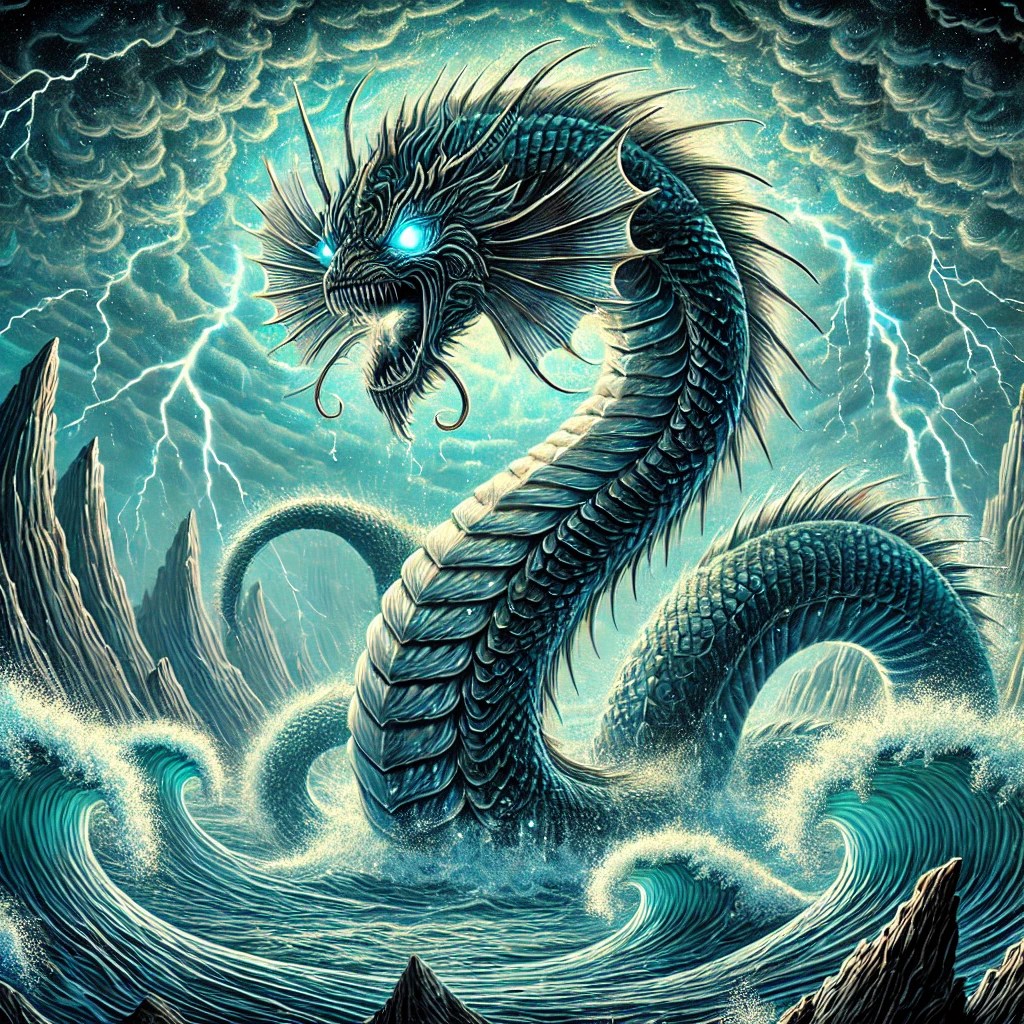
The book of Job stands as one of the most profound explorations of human suffering and divine sovereignty in Scripture. Among its many enigmatic passages, God’s discourse in Job 41 presents a vivid and awe-inspiring description of Leviathan, a creature of immense power and untamable nature. Far from being a mere description of a sea monster, this passage reveals something greater: God’s absolute authority over the forces of disorder.
More than a mythical beast, Leviathan embodies chaos, defiance, and opposition to God’s rule. Yet, in every instance where Scripture mentions it, God is the one who subdues and overcomes it. This pattern ultimately foreshadows Christ’s triumph over sin, death, and Satan, ushering in order and restoration where there was once rebellion and destruction.
Leviathan in Scripture
Leviathan is introduced in Job 41 as a creature beyond human ability to subdue. God challenges Job, saying:
“Can you draw out Leviathan with a hook, or snare his tongue with a line which you lower?” (Job 41:1)
This vivid imagery portrays Leviathan as a representation of chaotic forces, emphasizing humanity’s limitations and God’s unmatched authority.
The Bible references Leviathan in several other places, adding layers of meaning:
- Psalm 74:14: God defeats Leviathan, showcasing His power over destructive forces.
- Isaiah 27:1: God slays the “twisting serpent,” symbolizing His victory over disorder.
- Psalm 104:25-26: Leviathan is seen playing in the sea, demonstrating God’s supreme authority over all creation.
Leviathan as a Symbol of Chaos and Disorder
In ancient Near Eastern cultures, mythical sea creatures often symbolized primordial chaos.
For example:
- Canaanite myths describe Lotan as a chaotic beast defeated by Baal.
- Babylonian stories recount Marduk’s conquest of Tiamat.
These ancient myths depict a cosmic struggle between disorder and divine authority, often symbolized by the sea as a force of untamed destruction. In contrast, the Bible redefines this imagery to reveal God’s absolute supremacy. While pagan myths portray gods locked in battle with chaos, Scripture presents a radically different vision: The God of Israel does not strive against chaos. He speaks, and chaos is silenced. It is not an adversary He must overcome, but something subject to His word from the beginning.
As John Day explains in God’s Conflict with the Dragon and the Sea, the Bible engages with familiar imagery from Canaanite mythology but fundamentally reinterprets it. Yahweh does not wrestle with chaos. He commands it with a word, demonstrating His sovereign authority over all things. He speaks, and it is done (Genesis 1:3). Leviathan is not a rival deity or a force outside His control. It is a mere creature, fully subject to His will.
Christ’s Triumph: The Crushing of the Serpent and the Subduing of Leviathan
Throughout Scripture, serpentine imagery is often linked to forces opposing God’s will. The most notable example is in Genesis:
“Now the serpent was more cunning than any beast of the field.” (Genesis 3:1)
This deceptive serpent tempts humanity into rebellion against God. But God declares judgment:
“He shall bruise your head, and you shall bruise His heel.” (Genesis 3:15)
Just as Genesis 3:15 foretells the crushing of the serpent by the promised seed, Isaiah 27:1 envisions this triumph through the slaying of Leviathan, a symbolic representation of Satan’s ultimate defeat. Leviathan, described as a “twisting serpent,” is slain by the LORD’s great and strong sword. Many see this passage as a vivid portrayal of God’s final judgment upon Satan and the forces of chaos, reinforcing the unified biblical theme of the serpent’s demise through the power and authority of God fulfilled in Christ.
The New Testament confirms this interpretation:
- Revelation 12:9 explicitly identifies Satan as “the great dragon, that ancient serpent.”
- Colossians 2:15 describes how Christ disarmed “principalities and powers,” making a public spectacle of them.
- Hebrews 2:14 declares that Jesus destroyed “him who had the power of death, that is, the devil.”
Through Christ’s triumph, the serpent is crushed, Leviathan is subdued, and the dominion of sin and chaos is broken.
The Final Triumph of Truth
Leviathan is not merely a formidable creature; it stands as a menacing symbol of chaos and defiance against God’s sovereignty. In Christ, God’s triumph over sin and death reveals His supreme authority to redeem and restore what has been disordered.
This truth is captured in Hebrews 2:14:
“Since the children share in flesh and blood, He Himself likewise partook of the same things, that through death He might destroy the one who has the power of death, that is, the devil.”
The verse reminds us that even death and disorder are subject to divine power. The biblical portrayal of God’s dominion over Leviathan parallels Christ’s triumph over sin and death. Both narratives reveal that order is not achieved through struggle, but by the sovereign action of God. In Christ, the forces of chaos are not merely restrained; they are overcome.
References
John Day, God’s Conflict with the Dragon and the Sea: Echoes of a Canaanite Myth in the Old Testament, Cambridge University Press, 1985.


 Spread the Spirit
Leave a reply to Jared Matthews Cancel reply