

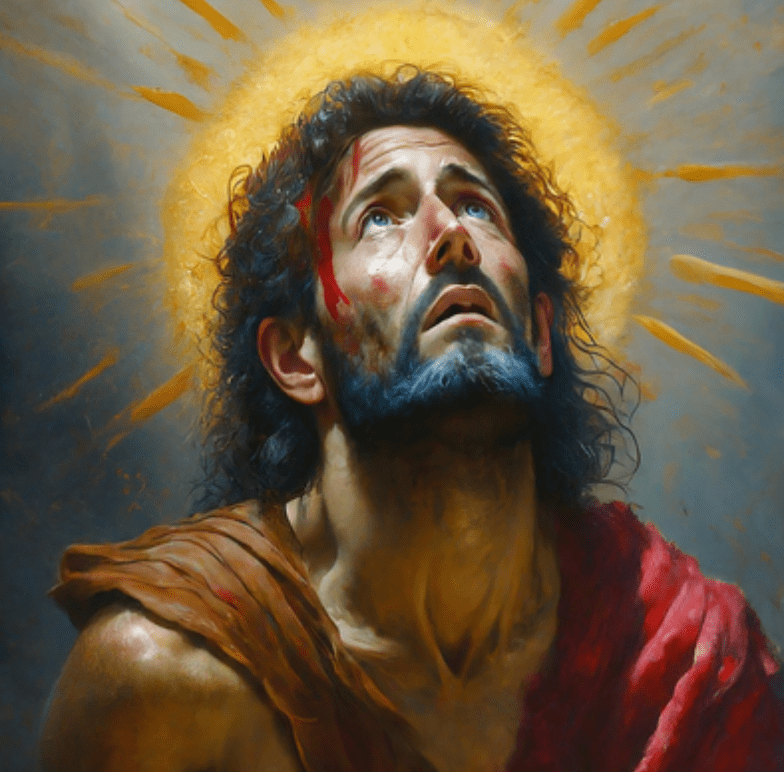
“While they were stoning him, Stephen prayed, ‘Lord Jesus, receive my spirit.’”— Acts 7:59
A Moment Beyond Words
Few scenes in Scripture are as profound as the death of Stephen. While his body was struck by stones, his eyes were lifted toward heaven. What he saw was not shaped by fear, nor by the rage of those around him. He saw the glory of God, and Jesus standing at His right hand. Then came the final prayer that would seal his testimony.
He simply said“Lord Jesus, receive my spirit.” There was no hesitation in his voice, no theological confusion. This was not a cry of desperation, but a deliberate act of faith from one who saw the truth clearly.
🕊 The Spirit Returns to God
The book of Ecclesiastes affirms that the spirit returns to God who gave it:
“Then shall the dust return to the earth as it was: and the spirit shall return unto God who gave it.” (Ecclesiastes 12:7)
This truth was foundational in the Hebrew understanding of life and death. The spirit, given by God, was not something man could claim as his own. It belonged to its Creator, and to Him it returned.
Stephen, already filled with that knowledge and illuminated by the Spirit, entrusted his own spirit to Jesus. Not to an angel. Not to an intermediary. He gave it to the one he recognized as the true giver of life.
“I am the resurrection, and the life. He that believeth in me, though he were dead, yet shall he live.”
— John 11:25
Stephen believed this fully. At the hour of death, he committed his spirit into the hands of the one who holds eternal life.
Throughout Scripture, no one else is ever entrusted with the spirit. Only God receives it. If the spirit belongs to God, and Stephen gave his to Jesus, the conclusion is not speculative. It is revealed in the clarity of that moment. Jesus, in the fullness of divine identity, receives what only God can receive.
👑 The Right Hand of God
Stephen’s vision was not of a divided heaven. He did not describe a scene with two thrones or separate beings. Scripture tells us:
“But he, being full of the Holy Ghost, looked up stedfastly into heaven, and saw the glory of God, and Jesus standing on the right hand of God, and said, Behold, I see the heavens opened, and the Son of man standing on the right hand of God.”
— Acts 7:55–56
The phrase “right hand of God” does not speak of a separate space. It speaks of divine authority. In Scripture, the right hand of God reflects the manifestation of His sovereign power and kingship.
What Stephen witnessed was not a division within the Godhead. The right hand of God is not a literal place beside another being, but a prophetic image of divine rule, revealed fully in the risen Christ. Jesus was not standing beside another. He was the visible expression of God’s glory.
For a deeper exploration of this theme, see my article on this:
Jesus as the Right Hand of God: Power, Authority, and Manifestation.
✝ A Mirror of the Cross
When Jesus died, He committed His spirit to the Father, speaking as the Son in humble submission to the unseen God. However, when Stephen died, he did not call upon the Father; instead, he invoked the risen Son by name. The One who had once entrusted His own spirit now receives the spirits of the faithful, for He is risen, glorified, and revealed as the right hand of God.
This is not a contradiction, but the fulfillment of a divine pattern. That which was hidden is now revealed. The Son is not distinct from the Father; He is the unveiled presence of the one true God.
Stephen beheld the conqueror of death, standing in glory. He did not see a servant, but the very expression of God’s authority. The resurrection did not position Jesus beside God; it revealed Him as God’s power and reign made manifest, victorious over the grave.
The same Spirit. The same power. The same identity. In Christ, the invisible God has become visible. The one who gave up His spirit on the cross is now the one who receives the spirit of the redeemed.
🙏 One Truth, One Lord
Stephen’s final cry was not divided among names. He did not look beyond Jesus for another. His plea was neither vague nor symbolic; it was marked by unshakable conviction and piercing clarity, addressed to the one he recognized as both Lord and God, echoing Thomas’s confession: “My Lord and my God.”
This was no ordinary moment. It was divine revelation. Heaven opened, the veil lifted. The one standing at the right hand of power was not merely a witness to God’s glory; He was the glory revealed.
Stephen saw with his eyes what his spirit had long believed. The man who had lived among them, spoken with authority, and risen from the dead now stood unveiled as the embodiment of divine power.
Jesus was not deferring to another. He received what belongs to God alone: the spirit of a faithful servant. And Stephen, without the slightest reluctance, offered up his spirit in a powerful testament to his unwavering faith in the divinity of Christ.
One name. One throne. One Lord and God.
Not a symbol. Not a shadow. Not a subordinate. The one enthroned in heaven was the same who had once dwelled among men. And Stephen, beholding Him in glory, knew exactly who He was.
🌟 The One Who Stood in Heaven
Stephen’s final words were not shaped by later traditions. They flowed from a man filled with the Holy Spirit, whose eyes were opened to the unveiled glory of God. His cry was not one of fear, but was given at the peak of absolute surrender, a recognition that the risen Christ is the visible expression of the one true God.
He spoke not to a servant of God, but to God Himself. Stephen did not hesitate, nor did he draw a line between God and the one before him. His loyalty was undivided. His conviction unshakable. His surrender complete.
May we behold Christ with the same clarity. And may we, in both life and death, entrust our spirit to the one who gave it and now stands ready to receive it again:
Jesus Christ, the Lord of glory.


 Spread the Spirit
Share your thoughts!